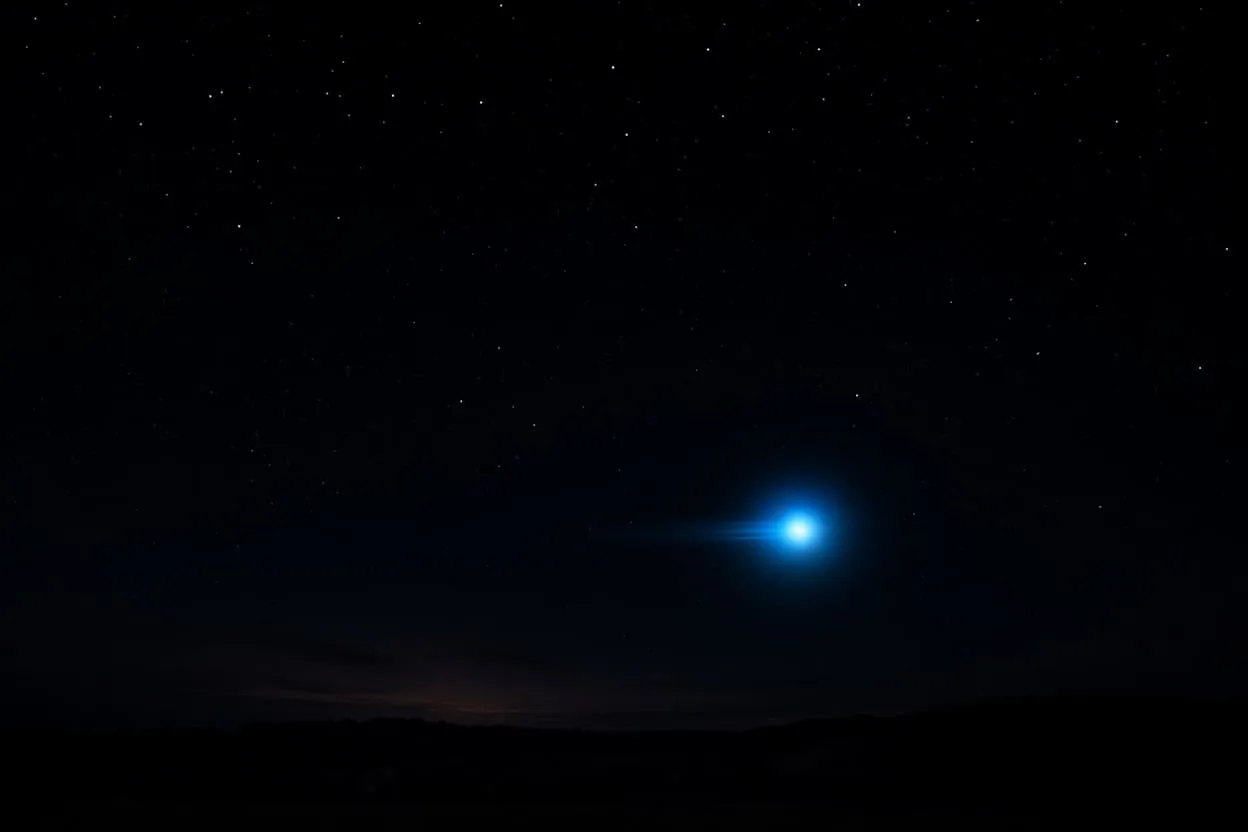
On September 12, 2026, at exactly 9:14 p.m., the sky above Les Aix-d'Angillon, a small town in the Cher department of central France, became the stage for a brief but intense phenomenon. The main witness describes a sequence in three distinct stages. First, a motionless blue point of light, smaller than a satellite. Then, almost immediately, what resembled a shooting star — except this one seemed to "explode" in the sky rather than simply fade out. Finally, emerging from the distance, a third object of indefinite shape but with a white brilliance far exceeding that of an aircraft, crossing the sky from south to west at a speed the witnesses judged well beyond that of a commercial plane.
The entire event lasted only two minutes. But the witness stresses a detail that recurs in nearly all sightings of this kind: total silence. No engine roar, no audible blast, even though the object was described as closer and faster than an airliner.
Six Witnesses, a Video Despite a Damaged Phone
Notably, this was not a lone observation but one shared by a small group of six people, including several direct neighbors, who could potentially corroborate the account independently — a detail investigators generally consider valuable, since multiple independent observers reduce the likelihood of a purely individual misperception.
The witness tried to film the scene on an iPhone 11 whose rear camera is damaged and normally struggles to capture faint, distant sources such as stars or satellites. Despite this technical limitation, the object was reportedly still recorded — a sign, some argue, of its exceptional brightness. An original video does exist, though it has not yet undergone independent authentication.
A Strikingly Methodical Sighting Report
The witness places the azimuth of the appearance at roughly 66° (northeast), with an angular elevation of about 25° above the horizon. The trajectory ran broadly from south to west before the object vanished. It is described as egg-shaped on the sighting form, though the narrative account emphasizes a diffuse, blinding white light more than any sharply defined outline — a common discrepancy between the box ticked on a form and what is actually experienced, where glare often prevents a clear silhouette from being distinguished.
The color is uniformly reported as an intense luminous white with no chromatic variation, which rules out certain leads such as ball lightning, typically associated with more orange or bluish hues. No sound was associated with the main object; only the silent "explosion" following the shooting star hints at a noise that, notably, no one actually heard.
The Cher: A Quiet Region, Not Entirely Free of Aerospace Sightings
Unlike regions such as Lorraine or the Larzac plateau, historically tied to France's major waves of sightings, the Centre-Val de Loire region has no particular reputation as a hotspot for unidentified aerospace phenomena. GEIPAN, the French space agency's dedicated study group, nonetheless logs a steady stream of reports there, as elsewhere in the country, classified on a scale from PAN A (fully explained) to PAN D (remaining unexplained after thorough investigation). The citizen-science network Vigie-Ciel, tied to the FRIPON fireball-monitoring program, also covers this part of the country. The nearby Bourges-Avord air base is another factor that serious investigators always weigh before entertaining more exotic explanations.
"It wasn't a plane, a star, or a satellite. It was faster, closer, and completely silent. I had never seen anything like it in my life." — Account gathered from the main witness
The Scientific Angle: Fireball, Space Debris, or Optical Effect?
The three-stage sequence described by the witness — a static point, an "exploding" shooting star, then a bright object streaking by in silence — strongly evokes a bolide, the technical term for a meteor whose brightness exceeds that of the planet Venus. The Vigie-Ciel network notes that such events, while spectacular, occur several times a year across France, consistently producing very similar testimonies: intense light, apparent high speed, and no sound heard at the moment of passage — since any sound from atmospheric fragmentation can take dozens of seconds to reach the ground.
A second hypothesis worth considering is the atmospheric reentry of space debris or a batch of Starlink satellites, an increasingly common occurrence since the deployment of low-orbit megaconstellations. Such reentries typically produce a slow-moving "train" of lights, sometimes with a brighter flash as a component breaks apart. However, the brevity of the event described here — two minutes — and its clear change of direction point, according to several amateur astronomers consulted on similar cases, more toward an isolated fireball.
What Researchers Have to Say
GEIPAN's classification carefully separates explained cases (PAN A) from those that remain wholly unexplained after a full investigation (PAN D) — a category that, contrary to popular belief, has historically accounted for only a minority of cases examined. Researchers such as astrophysicist Jacques Vallée and astronomer J. Allen Hynek argued for the scientific value of this residual category of unresolved cases, seeing in it a reason to question our perceptual categories rather than evidence of extraterrestrial visitation. In this instance, the lack of expert video analysis and the still-limited number of independently gathered testimonies call for caution: at this stage, the case looks more like a report awaiting investigation than a confirmed mystery.
On July 6, 2024, a father in Cebu, Philippines, published a Facebook post that would go on to be shared worldwide, circulating for two years across TikTok, X (formerly Twitter) and countless evangelical pages before resurfacing periodically in social media feeds. Joel Sia recounted the final moments of his son Jonathan, a 23-year-old student at the University of San Carlos in Cebu, who died one week before he was due to graduate Magna Cum Laude in Business Administration.
According to the father's account, since widely repeated, Jonathan had been hospitalized with a kidney disorder. Intubated as his condition worsened, he reportedly lost the ability to speak. In his final moments, he is said to have gestured toward his father as though he could see a presence in the room. Joel Sia says he handed him a pen and paper. Though extremely weak and trembling, the young man reportedly managed to write, in what his father described as perfectly legible handwriting, three words: "Jesus is real." Seconds later, he is said to have gone into cardiac arrest. His mother, at his bedside, says she saw a light and a hand lifting her son as he passed, a smile on his face.
A young man remembered for his faith
Jonathan Sia's relatives, quoted in the numerous social media retellings of the story, describe him as a young man of deep faith since childhood, nicknamed a "prayer warrior" by those close to him, who reportedly kept speaking about his faith to hospital staff even from his bed. A high-achieving student, he was about to graduate with honors when his health suddenly deteriorated.
It is this trajectory — the promise of a bright future, publicly professed religious devotion, and the suddenness of the kidney illness — that fueled the story's virality, elevating it through countless shares into a "testimony" and, for a significant portion of the English-speaking evangelical public and beyond, empirical proof of God's existence.
Reconstruction of the message shared by the family
What follows is a reconstruction, based on the consistent versions circulating publicly, of the testimony originally posted by Joel Sia on social media. It is not an official document but an illustrative synthesis of the reported statements.
"Before my son Jonathan was resuscitated, he signaled to me as though he was seeing someone, but I couldn't understand what he was trying to tell me. So I gave him a piece of paper and a pen so he could write it down. He was already very weak, shaking, barely able to hold the pen. Yet before the nurses called a Code Blue, he managed to write one final message: 'Jesus is Real.' It amazed me, because the words were so clearly legible. I believe he saw Jesus. My wife Aidy also witnessed a bright light and a hand lifting our son as he ascended. He was smiling."
"He could no longer speak because of the intubation. Yet in a matter of seconds, he traced three perfectly legible words." — Joel Sia, Jonathan's father
Terminal lucidity: a phenomenon documented by medicine
Jonathan Sia's case falls into a category of phenomena the medical literature calls "terminal lucidity," or paradoxical end-of-life lucidity. German psychiatrist Michael Nahm and Bruce Greyson, professor emeritus of psychiatry at the University of Virginia and a leading researcher on near-death experiences, have published several studies cataloguing cases of patients with advanced dementia, deep comas, or prolonged agonal states who unexpectedly regain mental clarity and the ability to communicate in the hours before death — a state seemingly at odds with their clinical condition.
This resurgence remains poorly understood physiologically. Proposed hypotheses include terminal neural discharges, sudden shifts in cerebral oxygenation, or a transient redistribution of cortical activity in the process of dying. None of these has achieved scientific consensus, and the rarity of the phenomenon — difficult to document in real time in an intensive care setting — severely limits the possibility of rigorous clinical study.
End-of-life visions as a research field in their own right
Alongside terminal lucidity, "end-of-life visions" or "deathbed visions" form a distinct field of research, notably explored by British neuropsychiatrist Peter Fenwick, whose studies examine perceptions reported by hospice patients. His work shows that dying patients frequently report perceiving presences, deceased relatives, or religious figures in the hours before death, regardless of their culture or prior beliefs.
Explanations proposed by the scientific community center mainly on neurological mechanisms: cerebral hypoxia, hypercapnia (carbon dioxide buildup in the blood), the release of neurotransmitters such as serotonin or dopamine during the dying process, and residual activity in the visual cortex in the absence of external stimulation. These mechanisms are documented in various clinical contexts, notably cardiac arrest, and have been studied extensively by American cardiologist Sam Parnia as part of the AWARE research program on consciousness after cardiac arrest.
What critical analysis of the account calls into question
Beyond the medical framework, several elements specific to this testimony's viral spread call for journalistic caution. First, no independently verifiable primary source — a medical record, a hospital statement, or a Filipino press article contemporaneous with the events — could be located beyond the social media posts and their successive reshares. The account rests entirely on the father's testimony, relayed second- or third-hand by faith-based accounts aimed at edification, a format that structurally favors the homogenization and embellishment of a story as it spreads.
Second, the versions of the testimony recorded over its spread show minor but notable variations: the exact nature of the kidney condition, the precise wording attributed to the father, and the description of the "hand" perceived by the mother all differ from one retelling to another — a classic sign of an oral or semi-oral account that sediments and dramatizes with each new transmission, a phenomenon folklorists know as narrative chain drift.
Finally, on a clinical level, the fine motor control required to write three legible words as an intubated patient in terminal multi-organ failure remains a rare but not impossible event: it precisely matches the clinical definition of terminal lucidity discussed above, without in itself constituting proof of the nature of the patient's subjective experience at that moment.
A phenomenon that extends beyond religious framing
It is worth noting that this type of testimony is not unique to evangelical Christianity. Researchers such as Icelandic psychologist Erlendur Haraldsson and American anthropologist Karlis Osis have documented similar end-of-life visions among Hindu, Buddhist, and non-religious patients, each perceiving figures consistent with their own cultural and symbolic framework — a point that proponents of a universal neurological explanation cite in their favor, while proponents of a transcendent explanation instead read it as evidence of a genuine experience simply translated into the language of each culture.
Conclusion: between neurology and transcendence
Jonathan Sia's case illustrates the persistent difficulty, given the current state of knowledge, of choosing between a strictly neurophysiological explanation of end-of-life phenomena and the transcendent interpretation defended by the families and faith communities involved. Neither mainstream medicine nor academic parapsychology currently offers a definitive explanatory framework for this type of episode — documented for centuries across every culture, yet whose rigorous scientific study remains, by its very nature, hampered by the unique, unpredictable, and non-reproducible character of each case.
Matthew Brown, the man behind the "Immaculate Constellation" dossier, says he still holds information he cannot legally disclose — and is publicly appealing to Donald Trump to release him from his oath of silence.
It is a rare gesture even in the already crowded history of revelations about unidentified anomalous phenomena (UAP): a former U.S. national security and policy analyst, Matthew Brown, has addressed the President of the United States directly on social media, asking for a favor of unusual gravity — to be released from his secrecy and non-disclosure obligations, and to have his family protected from retaliation he says he fears. His request, posted in mid-August 2026, immediately set the UFO community ablaze and reignited, once again, the debate over what the American government truly knows — and conceals — about unidentified flying objects.
Who Is Matthew Brown?
Brown first came forward publicly in May 2025, during a sprawling series of interviews with filmmaker and investigator Jeremy Corbell and journalist George Knapp, on their podcastWeaponized. By his own account, Brown worked as an analyst within the U.S. national security apparatus — a role that gave him access to classified networks such as JWICS (Joint Worldwide Intelligence Communications System), used by the intelligence community to share sensitive information.
It was while carrying out, he says, routine work on a shared server belonging to the Office of the Under Secretary of Defense for Intelligence and Security that Brown claims he stumbled — almost by accident — upon a misfiled document, tucked inside a folder labeled "2018 Schriever Wargames," a title deemed innocuous enough not to draw attention. That eleven-to-fifteen-page document, depending on the account, described an unacknowledged Special Access Program (SAP) code-namedImmaculate Constellation.
The "Immaculate Constellation" Dossier
The program's name first became public in October 2024, when independent journalist Michael Shellenberger reported it based on information from a then-anonymous whistleblower — now known to be Matthew Brown. According to that account, the program was allegedly created in 2017, in the wake of *The New York Times*' revelations about the existence of AATIP (the Advanced Aerospace Threat Identification Program), an earlier Pentagon effort to study UAP encounters.
The document reportedly describes high-quality images and video captured by U.S. intelligence platforms, classified and quarantined away from congressional oversight. Among the episodes cited: a formation of twelve metallic orbs flying in a tight "cuboid" formation over the ocean, large triangular objects appearing directly over naval vessels, saucer-shaped craft allegedly using cloud cover for concealment, and a thirteen-minute, high-definition video of a white orb emerging from the ocean near Kuwait, filmed from a helicopter and reportedly stored on SIPRNet.
On November 13, 2024, Republican Representative Nancy Mace of South Carolina held up the twelve-page document during a House hearing, calling it "this unacknowledged Special Access Program that your government says does not exist," before entering it into the official Congressional Record during a session devoted to UAP.
A Wall of Official Denials
The Pentagon's response has never wavered. From the earliest revelations, Department of Defense spokesperson Sue Gough stated: "The Department of Defense has no record, present or historical, of any type of SAP called 'Immaculate Constellation.'" Former AARO (All-domain Anomaly Resolution Office) director Sean Kirkpatrick likewise denied its existence.
AARO, the Pentagon's publicly acknowledged office for investigating UAP, has itself issued a report concluding there is no evidence UAP are extraterrestrial in origin, while acknowledging the existence of a separate program, Kona Blue, theoretically intended to study any reverse-engineering of recovered UAP technology — without confirming that any such recovery ever occurred.
Nearly two years after the initial leak, neither the White House nor the Pentagon has formally confirmed or denied the program's existence under that specific name beyond the original statement — a gray zone that believers in a cover-up read as telling, and skeptics attribute simply to the claims lacking any real foundation.
"Nothing in those videos necessarily proves it's extraterrestrial or non-human. But it certainly is anomalous, exotic, and unexplainable."
— Matthew Brown, interview with Jeremy Corbell and George Knapp,Weaponized, May 2025
The Plea for Immunity to Donald Trump
It was against this backdrop of prolonged stalemate that Brown chose, in mid-August 2026, to appeal publicly to President Trump. In a message posted to social media, he wrote: "Mr. President, I respectfully ask that you release me from all relevant secrecy and nondisclosure obligations and protect my family from those who wish to harm me for telling the American people the truth."
Brown states in his plea that he provided sensitive information to Senate and House members as early as 2023, concerning "unidentified anomalous phenomena, technologies of unknown origin, and non-human intelligence." He also raised concerns about "secrecy agreements and active threats," suggesting a genuine fear for his personal safety continues to hold him back from disclosing everything he knows.
What the UFO Community Is Saying
The plea sparked intense debate almost immediately on specialized forums, particularly the r/UFOs subreddit. Some commentators questioned what more Brown could possibly have to say that he hasn't already revealed. Others compared his cautious restraint to the more outspoken posture of fellow whistleblower Luis Elizondo, former head of the AATIP program, who has previously spoken publicly about fearing "elimination" over his own disclosures.
Other users speculated that the Immaculate Constellation dossier might contain material classified at a higher tier, currently beyond Brown's legal reach — a restriction that would presumably lapse at some as-yet-unknown date. Part of the online discussion also linked Brown's move to more speculative themes raised during his earlier appearances with Corbell and Knapp, where he reportedly touched, obliquely, on simulation theory and the nature of consciousness — subjects some believe his non-disclosure agreements prevent him from discussing openly.
Documentarian and journalist Jeremy Corbell has defended Brown's approach, saying he had "done everything right" before resolving to go public: "Congress has made a show of this, that they want whistleblowers to come forward. Well, here you go. Matthew Brown has inside knowledge of the deception of our government by elements of the intelligence community."
Two distinct prophecies, separated by more than sixty years and by radically opposed methods — the trance of a blind mystic and the calculation of a physicist — converge on the same months of autumn 2026. On one side, predictions attributed to the Bulgarian mystic Baba Vanga foretell a first extraterrestrial contact, major geological cataclysms and a decisive geopolitical shift. On the other, a demographic equation published in 1960 fixes November 13, 2026 as a theoretical tipping point for humanity. A closer look at two legends that were never, in fact, meant to meet.
The Bulgarian seer's predictions for 2026
Vangelia Pandeva Gushterova, known as Baba Vanga, who died in 1996 at the age of 85, remains one of the most cited figures in 20th-century clairvoyance. Her admirers credit her with retrospective predictions concerning the death of Princess Diana and the September 11, 2001 attacks, claims that have become a central part of the legend surrounding her name. For 2026, the compilations circulating online attribute to her several major announcements: an extraterrestrial contact in November, natural disasters of unprecedented scale, a major war originating in the East, and the rise of artificial intelligence taking an ever-growing place in daily life, to the point of affecting even the most basic routines.
One methodological difficulty deserves mention: Baba Vanga left no writings during her lifetime, and she died on August 11, 1996, which makes it impossible to directly verify any statement attributed to her. Nearly all the "prophecies" circulating today come from collections published after her death by relatives or admirers, often translated and reworded several times over — a classic mechanism of legend-building that folklorists call retrospective prophecy.
Alien contact in November: where the rumor came from
The most spectacular prediction concerns the supposed arrival of an extraterrestrial spacecraft in Earth's atmosphere. The most widespread versions describe a massive craft approaching Earth in November 2026, a scenario several outlets have recently linked to the media frenzy surrounding the interstellar object 3I/ATLAS, discovered by astronomers, whose passage through the solar system has fueled no shortage of speculation. Some versions of the prophecy go further, suggesting humanity could establish communication with a civilization already present on our planet — an idea that echoes ufological theories far older than Baba Vanga herself.
The broader context hasn't helped calm things down: the recent surge in videos of unidentified aerial phenomena and military testimony has pushed the prophecy back into the spotlight. Ufologists nonetheless point out that the calendar coincidence between a well-documented cometary passage and a vague prophecy with no original fixed date is a textbook case of after-the-fact confirmation bias.
Earthquakes, eruptions and climate upheaval
The geophysical portion of the predictions is no less dramatic. The collections describe massive earthquakes, violent volcanic eruptions and extreme weather events affecting between 7 and 8% of the planet's landmass over the course of the year. No dated primary source allows this figure to be verified; it has circulated from site to site for years, generally without any scientific reference attached.
It's true that 2026 sits within a sequence of climate records and rising geopolitical tensions, which partly explains the particular resonance of these claims: the prophecy, vague by nature, lends itself to a reading that always seems to fit the news of the moment — a phenomenon cognitive psychologists trace to the Barnum effect, the tendency to find personal meaning in broad, general statements.
A "doomsday equation" resurfaces from the past
More unsettling on the surface: a second prediction, this one scientific, also points to the fall of 2026. Resurfacing on social media over the past several months, it draws on a genuine article published in the journal Science in 1960. Its authors, the Austrian physicist Heinz von Foerster along with his colleagues Patricia M. Mora and Lawrence W. Amiot of the University of Illinois, examined nearly two thousand years of world population data.
Their finding was that human population growth did not follow a simple linear progression but appeared to accelerate continuously. Extrapolating that curve, the mathematical model arrived at a theoretically infinite population on a precise date: Friday, November 13, 2026. The article, which became known as the "Doomsday equation," is genuine and can still be found in Science's archives — this is not an urban legend invented from whole cloth, unlike many similar stories.
Who was Heinz von Foerster?
Far from a fringe figure, von Foerster was a pioneer of cybernetics, artificial intelligence and biophysics, who worked with the Pentagon and received a Guggenheim fellowship twice. His solid academic standing is part of why his "Doomsday equation" continues to be taken seriously by some, rather than dismissed outright as a curiosity.
One unsettling detail that viral shares never fail to mention: November 13 is also von Foerster's own birthday, born in Vienna in 1911, which has led several commentators to describe it as a mischievous wink from the researcher toward himself rather than a purely mathematical coincidence.
"World population, on that date, will tend toward infinity if it continues to grow as it has over the past two millennia." — Heinz von Foerster, Patricia M. Mora and Lawrence W. Amiot,Science, 1960 (free translation)
Reconstructed archival document — reader's note, November 1960
Reconstructed facsimile of a reader's note submitted to the "Correspondence" section of a European scientific journal, following the publication of von Foerster's article in Science.
"Science publishes this month an article certain to attract considerable attention, both for the rigor of its method and the strangeness of its conclusion. Dr. von Foerster and his collaborators from Illinois demonstrate, figures in hand, that the growth of the world's population has for centuries followed a hyperbolic law rather than the exponential one generally assumed. Carried to its mathematical conclusion, this law points to a precise day next century — a Friday in mid-November of 1926... pardon me, 2026 — as a moment of theoretical singularity. The authors themselves take care to note that this is an extrapolation meant to warn policymakers of the dangers of uncontrolled growth, not a prophecy in the literal sense. Still, the choice of so distant a date, and the warning it carries, will no doubt inspire, sixty-six years from now, interpretations its authors never anticipated."
A critical look: what scientists say today
Sixty-six years after its publication, von Foerster's equation has been thoroughly reassessed by the scientific community. Von Foerster himself never intended the date to be taken literally: his goal was to illustrate the dangers of overpopulation, not to announce a literal deadline. Since 1960, several factors have substantially altered the world's demographic trajectory: global population growth has slowed considerably, largely due to falling birth rates across many regions of the world.
No contemporary, peer-reviewed scientific assessment predicts a literal end of the world on November 13, 2026; the 1960 mathematical singularity was always meant as illustrative rather than predictive. Current demographic data in fact run counter to the doomsday scenario: global fertility has declined across many regions, and more than half the world's countries already show negative population growth rates — a situation exactly opposite to what the 1960s model anticipated.
As for the prophecies attributed to Baba Vanga, their scientific footing is even thinner, given the absence of any dated, verifiable primary source. Specialists in contemporary folklore see it as a textbook case: a body of vague texts, assembled after the fact, in which every reader finds the anxieties of their own era — whether climate change, international tensions, or the renewed fascination with unidentified aerial phenomena.
Some coincidences are so strange they end up looking like prophecies. This one involves a former SS officer who became the father of the American space program, a science-fiction novel rejected by eighteen publishers, and the richest man in the world. At the heart of the affair: a single word, "Elon," used nearly eighty years before that name became synonymous with rockets, electric cars, and the conquest of Mars.
The story goes back to the immediate postwar period. Wernher von Braun, chief engineer of the Nazi V-2 missile program, had just been smuggled into the United States as part of Operation Paperclip. Based at Fort Bliss, Texas, he wrote a manuscript in German between 1948 and 1949 titled Marsprojekt, a speculative novel in which he imagined, with an engineer's precision, a human expedition to Mars and the political organization of the colony that would result from it.
"Elon," the Title of Mars' Head of Government
It is in Chapter 24 of the book, soberly titled "How Mars Is Governed," that the sentence which would, decades later, set social media ablaze, is tucked away. Von Braun describes a Martian government led by ten men, whose leader is elected by universal suffrage for a five-year term and holds the title of "Elon." This leader is assisted by a cabinet and a bicameral parliament, including an upper chamber, the Council of Elders, made up of sixty members he appoints himself for life.
"Elon" is therefore not a first name in von Braun's text: it is a function, somewhat like referring to a "chancellor" or a "consul." The German engineer never explains it and does not indicate where the word came from — an ambiguity that would fuel every speculation decades later.
A Cursed Manuscript, Published Sixty Years Too Late
Von Braun tried without success to have his novel published in the United States: eighteen American publishers turned him down one after another. Only the book's technical appendix, stripped of its fictional storyline, was published in 1953 under the titleThe Mars Project, by the University of Illinois Press — it was this purely scientific text that would later influence NASA. The novel itself, with its plot and its "Elon," remained unpublished for nearly sixty years.
It was not until 2006 that a small Canadian specialty publisher, Apogee Books, finally unearthed and published the full text under the titleProject Mars: A Technical Tale. The passage about the "Elon" was therefore only made public — in English, widely accessible — sixty years after it was written, and thirty-five years after Elon Musk himself was born, in 1971.
The Startling Testimony of Elon Musk's Father
The affair might have remained a bibliophile's curiosity had Errol Musk, Elon's father, not spoken publicly about it in 2022, in an interview posted on YouTube. He explains that he grew up in South Africa reading, as a child, illustrated books by Wernher von Braun and his mentor Hermann Oberth, in which he recalls learning that the leader of the Martian colony held the title of "Elon." According to him, this childhood memory resurfaced when the time came to choose his son's name — all the more so, he adds, because the boy's maternal great-grandfather was in fact named Elon Haldeman, a family coincidence that finally convinced him.
Elon Musk himself reacted to the resurgence of this story on the social network X, joking that it had all been "foretold in the prophecy," without claiming any further mysticism around his own first name.
What the Archives Say
"The Martian government was directed by ten men, the leader of whom was elected by universal suffrage for five years and entitled 'Elon.' Two houses of parliament enacted the laws to be administered by Elon and his cabinet."
— Wernher von Braun,Project Mars: A Technical Tale, Chapter 24, "How Mars Is Governed" (written 1948–1949, published 2006)
Reconstructed Excerpt — Rejection Letter from an American Publisher (1949)
None of the eighteen rejection letters received by von Braun has ever been made public in full. Based on accounts gathered by his biographers and the editorial practices of the era, here is a reconstruction of the kind of letter the engineer might have received, offered as an illustration of the publishing climate in which his manuscript was rejected:
"Dear Dr. von Braun, thank you for submittingMarsprojektto us. While the technical calculations accompanying your narrative are of unquestionable rigor, our editorial committee finds that the fictional storyline lacks the sweep needed to engage a general readership. We encourage you to develop the scientific appendix as a standalone work."
(Illustrative reconstruction based on postwar American publishing conventions — no original of these letters has been located to date.)
Troubling Coincidence, or a Story Reconstructed After the Fact?
Researchers and journalists who have examined this affair urge caution. Several elements weaken the "prediction" thesis. First, the timeline: the passage about the "Elon" only became accessible in English in 2006, by which time Elon Musk was already 35 — Errol Musk's account therefore rests on a childhood memory from South Africa in the 1950s and 1960s, a period when only a limited German-language version of the manuscript could have circulated, something difficult to verify independently.
Second, the word "Elon" was not von Braun's invention: it is an attested biblical name (one of the Judges of Israel in the Old Testament is named Elon), which makes it less improbable that a South African child of Protestant background might have encountered it elsewhere, independently of the novel.
Finally, the story spread and amplified widely on social media starting in 2018, at a time when Elon Musk was already publicly cultivating a near-messianic image as a figure of space conquest — fertile ground for retrospective narrative reconstruction, a phenomenon well documented in social psychology as confirmation bias.
Even so, the lexical coincidence itself is undeniable and verified in the original German text: von Braun did write the word "Elon" to designate the leader of Mars, nearly twenty years before the birth of the man who now dreams of sending the first colonists there.
It is a little past eleven o'clock at night on Sunday, August 12, 1917, when two night watchmen employed at the Durango coal tipple, Messrs. Crawford and Ellis, notice an unusual light hanging above the western horizon. The object, which they would later describe as resembling an "illuminated airship," appears to hold position in the direction of Mancos, a small farming settlement located roughly twenty-five miles west of Durango, in the heart of Montezuma County. The light remains visible for about half an hour before fading out or slipping behind the hills.
The phenomenon does not end there. Around three o'clock in the morning, the same light — or at least a light of identical character — reappears at the same point on the horizon. This second appearance is briefer, lasting only about ten minutes. While several Durango residents claim to have observed the first manifestation around eleven o'clock, few remain awake at the hour of the second, considerably limiting the number of corroborating witnesses for this phase of the event.
The affair is reported the following day by theDurango Semi-Weekly Herald, under the laconic headline "Seeing Things After Night" — a title whose wording already betrays, in the editor's choice of words, a blend of curiosity and cautious skepticism typical of regional newspapers of the period.
A Coal Tipple as Observation Post
The location from which the sighting was made is not incidental. In 1917, the Durango coal tipple was a nerve center of local mining activity, the town then serving as an important railway and industrial hub of southwestern Colorado, fed by coal mines and by the traffic of the Denver and Rio Grande Railroad. The night watchmen who worked there spent long hours outdoors in the dark, offering a privileged — and above all continuous — vantage point over the night sky, unlike the majority of residents asleep at that late hour.
Mancos, the settlement toward which the light pointed, sits within a region of arid plateaus and mesas, not far from the future boundaries of Mesa Verde National Park, established just a few years earlier, in 1906. The rugged terrain and the near-total absence of artificial lighting in 1917 would have made any isolated light particularly conspicuous — and ripe for every kind of interpretation.
Colorado Under Tension: A Summer of War
To understand how this light was perceived, it must be placed within its immediate historical context. The United States had entered the war against Germany on April 6, 1917, barely four months before the Durango sighting. The entire country was then gripped by a fever of espionage: rumors of German saboteurs, fear of coastal aerial attacks, widespread suspicion toward any unidentified flying object. This atmosphere was not unique to the United States: as early as 1912-1913, Britain had already experienced its own "phantom airship panic," with thousands of witnesses claiming to see German Zeppelins that, according to historians, simply did not yet exist at that operational scale.
The phenomenon of "phantom airships" was, in fact, nothing new by 1917. The United States had already experienced a spectacular wave of similar reports in 1896 and 1897, stretching from California to Texas, without any definitive explanation ever being reached. The war merely reactivated and intensified this climate, giving it a new coloring: the enemy was no longer a mysterious inventor, but a foreign spy. The Mancos light, in this context, is not an isolated occurrence but fits within a long American tradition of aerial sightings open to the widest range of interpretations, from spy balloon to secret military aircraft.
"The object appeared to be in the direction of Mancos and was visible for about half an hour." —Durango Semi-Weekly Herald, August 13, 1917
Rational Hypotheses and Possible Explanations
Several natural or technical explanations have been advanced, retrospectively, for this type of sighting typical of the early twentieth century:
A planet or bright star.In August 1917, Venus was visible in the evening sky under certain configurations, and a bright planet near the horizon, distorted by atmospheric refraction, can easily take on a misleading hue and brilliance for an untrained observer — a well-documented phenomenon in ufological annals, later studied notably by astronomer J. Allen Hynek in his work for the US Air Force.
An observation or advertising balloon.Tethered balloons, weather balloons, and sky lanterns (Chinese lanterns) enjoyed a certain popularity at the time and could drift over long distances, producing an oscillating light easily mistaken for a piloted craft.
A distant brush fire.The Mancos region, arid in summer, could experience wildfires whose glow, carried by the night atmosphere, might have created the illusion of a suspended light.
A rare atmospheric phenomenon.Some researchers in meteorology raise the possibility of electro-atmospheric phenomena, akin to St. Elmo's fire or forms of ball lightning, though these hypotheses remain marginal and unverifiable for an event this old.
None of these explanations, however, has been either confirmed or definitively ruled out: the original article provides neither a precise bearing in degrees, nor an exact duration beyond the witnesses' estimates, nor any description of the light's color or movement, which considerably limits any rigorous retrospective analysis.
Reconstructed Document — Watch Report from the Coal Tipple Post
What follows is an archival reconstruction, built from the elements reported by the Durango Semi-Weekly Herald, intended to illustrate the form a night watch report might have taken at the time. It is not an authentic document that was recovered, but an editorial restitution.
Watch Post — Coal Tipple, Durango, Colorado Night of August 12–13, 1917 Observers: J. Crawford, A. Ellis
11:05 PM — Light sighted on the western horizon, approximate direction of Mancos. Constant intensity, no twinkling characteristic of a star. No sound perceived. 11:10 PM — Light remains stationary or moves very slowly. Altitude impossible to determine. 11:35 PM — Light disappears, either by extinction or by occultation behind the terrain. 3:00 AM — Reappearance at the same point on the horizon. 3:10 AM — Final disappearance. End of observation.
A Critical Look
As with the vast majority of early twentieth-century aerial sightings, the Durango observation suffers from a glaring lack of objective data: no photograph, no angular measurement, no direct written testimony from the observers themselves beyond the newspaper's summary. The wording chosen by the Herald's writer — that the object "looked not unlike an illuminated airship" — betrays a telling rhetorical caution: the journalist offers a comparison without ever asserting it as fact.
The context of a newly begun war, the temporal proximity to the United States' entry into that war, and this sighting's place within a long lineage of "phantom airships" documented since 1896 all call for methodological caution rather than hasty conclusions. Whether the Mancos light was a celestial body, a distant fire, a stray balloon, or — as some anxious contemporaries suggested — a craft of unknown origin flying over American territory in wartime, the event remains above all a valuable testimony to the collective state of mind of a small Colorado mining town in the summer of 1917.
It was a short, dry dispatch carried by the United Press wire out of New York that threw the small town of Jamaica, on Long Island, into a state of excitement in the closing days of December 1907. According to the account later published by thePueblo Sunof Colorado, a large balloon had appeared over the town, low and visible enough that the entire population was, in the words of the original dispatch, "all worked up."
What struck witnesses was not so much the presence of a balloon — ascensions were a fairly common sight along the East Coast at the time — but the way it was rigged: a lantern was said to be suspended from a rope dangling some twenty feet below the basket. This unusual proximity between a naked flame and the enormous gas-filled envelope reportedly caused even more astonishment than the unexpected appearance of the airship itself. No aeronautical club and no local gas company had claimed or reported a launch matching this description.
An America Already Accustomed to "Mystery Airships"
To understand the resonance of this episode, it helps to place it within a broader timeline. From the autumn of 1896 through the spring of 1897, the United States had already lived through what historians now call the "mystery airship" wave: thousands of witnesses, from California to Texas to Nebraska and Missouri, reported sighting aerial craft equipped with powerful searchlights, sometimes described with a level of technical detail that far outstripped the known aeronautical capabilities of the era. On November 17, 1896, theSacramento Beeopened this series with an account of a light crossing the city's sky; a few months later, tens of thousands of people claimed to have watched an enormous craft pass over Kansas City on a single day in April 1897.
The phenomenon was nothing new even in 1896: as early as November 1876, the Sacramento press had already reported the appearance of a comparable light, likened to an "electric arc lamp propelled by some mysterious force." Professor George Davidson, quoted by theSan Francisco Chronicle, attributed it to a "freemasonry of liars" who had sent up a balloon fitted with a lighting device — an explanation that would become a classic of the genre: the collective hoax, carefully maintained by a handful of pranksters and amplified by the popular imagination.
This lineage sheds a particular light on the Jamaica sighting: a full decade after the great Midwestern wave, the mere sight of a balloon carrying a lantern was still enough to stir an entire town, proof that ballooning remained, for the East Coast public, territory charged with a mixture of technical fascination and near-supernatural unease.
What the 1907 Aeronautical Context Tells Us
The year 1907 is no coincidence. It was precisely during this period that the Aero Club of America, founded in New York in June 1905, was staging its most spectacular ascensions yet, launching from its bases in Pittsfield and North Adams, Massachusetts, in preparation for the Gordon Bennett international balloon cup, which it was set to host on American soil after its surprise victory in Paris the previous year. Recognized aeronauts such as Leo Stevens — a New York-based balloon maker — and Alan R. Hawley were multiplying test flights, some covering several hundred miles.
Yet these same records show that Aero Club aeronauts carefully avoided flying over Long Island Sound, considered too risky for an emergency landing in the event of trouble. A balloon drifting over Jamaica, at the western tip of Long Island, would therefore hardly fit the deliberate route of a serious club expedition — which lends weight to the hypothesis, still favored today, of an amateur balloon, poorly controlled, drifting on the December winds, rather than an organized and officially declared flight.
Quote
"The fact that a light was in such close proximity to the huge gas bag caused even more surprise than the unexpected appearance of the big airship." — United Press dispatch, reprinted in thePueblo Sun, December 28, 1907
Reconstructed Document: Wire Desk Note
WESTERN UNION TELEGRAPH -- PRESS SERVICE
FROM: New York Bureau, United Press
TO:   Subscribing Newsrooms
DATE: December 28, 1907

RE -- BALLOON REPORTED OVER JAMAICA LONG ISLAND STOP
TOWNSPEOPLE ALL WORKED UP STOP WITNESSES DESCRIBE
LARGE GAS BALLOON WITH LANTERN SUSPENDED ON ROPE
ABOUT TWENTY FEET BELOW BASKET STOP NO ASCENSION
RECORDED THIS DATE IN KNOWN REGISTERS STOP ORIGIN
OF CRAFT NOT ESTABLISHED STOP END MESSAGE
Critical Perspective
Absent any photographic record or official ascension report matching the date and location, the Jamaica episode remains, on the documentary level, a simple wire brief — a format known for prizing sensational effect over cross-checking. Historians of American aeronautics note that no flight organized by the Aero Club of America, then the only New York-based body capable of mounting official and tracked ascensions, is recorded for the Long Island area on that date.
The most probable explanation, already advanced for dozens of comparable sightings between 1876 and 1897, remains that of a pilot balloon or a recreational balloon released by a private individual or a group of amateurs, drifting without a declared operator and fitted with a lantern to signal its presence at night — a common enough practice at the time, carrying no intent to deceive. The reported proximity between the flame and the gas envelope, if accurate, likely reflects the technical carelessness of the period rather than an unexplained phenomenon: gas balloons in 1907 were not designed to carry an open flame, and such testimony may well have been amplified by general alarm rather than by precise observation in the winter darkness.
Even so, this near-anecdotal episode illustrates how the American press of the turn of the century could turn a simple unidentified flying object — a stray balloon, a lantern swaying in the wind — into a small local mystery, within a climate already shaped by a decade of ghostly "airship" tales.
Légende - Photo Antony-22, CC BY-SA 4.0, https://commons.wikimedia.org/w/index.php?curid=60483791
He was supposed to talk about football. He ended up talking about the sky. Called up by head coach Luis de la Fuente for the resumption of 2026 World Cup qualifying, Atlético Madrid midfielder Marcos Llorente was returning to the Roja after more than a year's absence. But it was neither his physical form nor his place in Spain's midfield that dominated discussion around his call-up. It was another outing on one of the most controversial subjects in the contemporary conspiracy world: chemtrails, those white trails left behind by aircraft, which some still insist are the vector for a deliberate chemical spraying operation concealed by the authorities.
Questioned by the Spanish sports outlet El Desmarque, Llorente did not dodge the subject. "I say it very naturally," he stated, before adding: "When I used to look at the sky, I didn't see these things." A calm, almost matter-of-fact tone, for a conviction that has accompanied him for several years now and that, far from fading, seems to strengthen with every new public statement.
"It's not normal": the case built by a player turned figure of doubt
According to remarks reported by several Spanish outlets, Llorente claims that the trails now observed in Iberian skies did not exist, or at least not in this form, when he was a child. "It's not normal," he reportedly insisted, adding that he was not "the only one saying it." He goes so far as to claim that "thousands of people" thank him, in his telling, for having brought the subject into public discussion. "A lot of people say it, and more and more people are saying it," he insists, building his case not on scientific evidence but on the notion of a growing popular consensus.
This type of argument, grounded in the supposed multiplication of testimonies rather than in any verifiable demonstration, is a constant feature of conspiracy theories linked to aviation and geoengineering. It rests on a cognitive bias well documented by social scientists: the conviction that the perceived frequency of a shared opinion guarantees its validity, regardless of the objective data available.
The origins of a myth: where do chemtrails come from?
The chemtrail theory, a contraction of "chemical trails," has its roots in the 1990s United States. It crystallized in particular around a US Air Force document titled "Weather as a Force Multiplier: Owning the Weather in 2025," published in 1996 as part of a university-level forward-looking exercise on the future military uses of meteorology. That text, routinely stripped of its academic context by proponents of the theory, has become one of the favorite pieces of evidence for a movement claiming that the long condensation trails left by airliners at high altitude are not a simple physical phenomenon, but the result of intentional spraying of chemical or biological substances, for purposes ranging from climate control to population manipulation.
The scientific community has been unanimous on this theory for more than two decades. The trails observed, scientifically known as "contrails" (condensation trails), result from a thoroughly documented physical process: the condensation, then crystallization, of water vapor contained in jet engine exhaust upon contact with the cold air of high altitudes. An international study coordinated in 2016, bringing together 77 atmospheric specialists from nineteen countries and published in the journal Environmental Research Letters, had already concluded that 76 atmospheric dust samples analyzed showed no evidence of a clandestine spraying program, while also finding that the persistence of certain trails in humid high-altitude air fully explains the grid-like patterns often cited as proof by theory proponents.
An athlete, a sounding board
What sets the Llorente case apart from a simple opinion shared on social media is the sounding board that elite sport represents. At 31, the Spanish international, who came through Real Madrid's academy before joining Atlético in 2019, enjoys considerable public standing in a country where football occupies a central place in public life. His words, whether spoken on the pitch or off it, reach a broad and varied audience, well beyond the circles usually receptive to conspiracy theories.
This is, moreover, not the first time the player has ventured into a lifestyle marked by distrust of conventional scientific and medical institutions. Llorente has also spoken publicly about his daily habit of adding butter to his coffee, which he presents as beneficial for the body, as well as his dedicated practice of red-light therapy, to the point of launching his own business selling infrared lamps. The player says he structures his days around sun exposure and, once night falls, the exclusive use of red and infrared lighting throughout his home, in order to reproduce, in his words, lighting conditions as close as possible to natural twilight.
Quote
"A lot of people say it, and more and more people are saying it. It's not normal."
— Marcos Llorente, interview with El Desmarque, July 2026
Sport and disinformation: shifting ground
Llorente's case is not isolated in the international sporting landscape. Figures from disciplines as varied as tennis, American basketball, and rugby have, in recent years, lent their fame to claims rooted in scientific disinformation, whether concerning the shape of the Earth, vaccines, or, precisely, chemtrails. Sports federations, including Spain's Royal Football Federation, regularly find themselves at a loss in the face of this kind of individual stance, which falls outside any standard disciplinary framework but repeatedly raises the question of elite athletes' public responsibility.
Head coach Luis de la Fuente, focused on preparing the squad for the upcoming World Cup qualifying fixtures, has so far made no public comment on his player's remarks. The Roja, meanwhile, continues its preparations, while the Spanish media landscape once again grapples with the growing porousness between sporting fame and the spread of unverified theories.
A belief that persists despite the denials
Several opinion surveys conducted in Europe and the United States over the past decade have highlighted the persistence of a significant minority of the population convinced, to varying degrees, of the reality of a clandestine atmospheric spraying program. This persistence puzzles researchers in the sociology of belief, who see it less as an information gap than as a broader distrust of scientific, governmental, and media institutions. In this context, the voice of a well-liked and respected public figure — such as a Spanish international playing for one of the country's biggest clubs — acts as a powerful vector of legitimization, regardless of the theory's complete lack of empirical grounding.
Marcos Llorente, for his part, shows no sign of backing down. Fully standing by his views, including within the official setting of a national team gathering, he illustrates in his own way a broader trend: athletes who, buoyed by their popularity, choose to use their media platform to voice personal convictions far removed from scientific consensus, blurring the line between sporting performance and activist speech.
A post circulating on X has attracted significant attention after claiming to reveal a series of dramatic events that will allegedly unfold in 2026 and 2027. Shared by the account @Gdams70T, the thread presents what it describes as an "urgent prophecy" from a young boy named Jesús López, warning of the arrival of the biblical end times.
The post urges users to translate and share its contents worldwide before it is supposedly censored. However, there is no evidence that the claims are based on verified information. They reflect religious and apocalyptic beliefs rather than established facts.
The "Triad of Perversion"
The first claim centers on what the post calls the "Triad of Perversion."
According to the thread, three well-known public figures play key roles in the approaching end times:
Elon Musk is identified as Satan.
Jared Kushner is described as the Antichrist.
MrBeast is portrayed as the Beast from the Book of Revelation.
The post provides no evidence to support these allegations, which are presented as prophetic interpretations rather than factual claims.
A Global Pandemic in 2027
The prophecy goes on to predict the outbreak of a devastating worldwide pandemic between January and April 2027.
It identifies the threat as a norovirus, a real virus that commonly causes outbreaks of gastroenteritis. According to the post, this virus would spread globally during the 2026 FIFA World Cup, leading to destruction on a scale comparable to the Black Death.
At present, no public health authority has issued any warning supporting such a scenario.
The Destruction of Major Cities
The thread also predicts a series of catastrophic natural disasters.
It claims that New York, described as the biblical "Babylon," along with São Paulo and Hawaii, will be destroyed. The post attributes these events to the Leviathan, a mythical sea creature mentioned in several religious texts.
It further predicts that San Francisco will be struck by a historic mega-tsunami, with waves reaching heights of up to 32 meters (105 feet).
There is currently no scientific evidence supporting these predictions.
The Giants of the Euphrates
Among the most extraordinary claims is the prediction that the fallen angels imprisoned beneath the Euphrates River will soon be released.
According to the post, these beings will emerge on Earth in the form of giants, fulfilling a prophecy linked to the Book of Revelation and other biblical passages.
This claim is based on religious interpretations and is not supported by factual evidence.
A Call to Spread the Warning
The final part of the thread urges readers to translate the message into as many languages as possible in order to warn people around the world.
It also encourages users to bookmark the post so they can compare its predictions with future events in 2026 and 2027. Finally, it suggests that the information could be censored—a common theme in conspiracy-related content designed to encourage wider sharing.
Between Prophecy and Viral Content
Predictions of the end of the world have circulated for decades, often blending biblical symbolism, conspiracy theories, political figures, and natural disasters into a single narrative.
The viral thread attributed to Jesús López follows this pattern. While it has generated discussion across social media, there is currently no evidence supporting its extraordinary claims. As with any sensational online content, readers should distinguish between personal beliefs, religious interpretations, and information that can be independently verified.
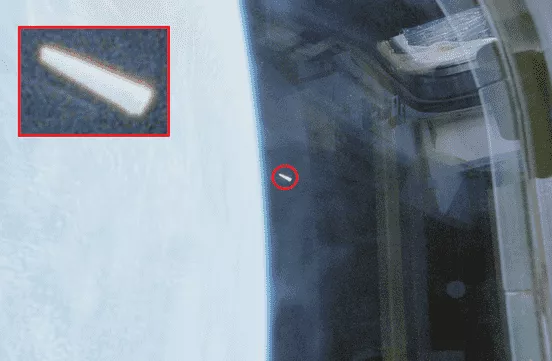
In November 1996, during the STS-80 mission of Space Shuttle Columbia, astronauts photographed an unidentified object in low-Earth orbit. The object appears near the center of the image, to the right of Earth's limb, standing out clearly against the dark background of space.
Its unusual shape and the lack of a detailed official explanation have raised many questions over the years. Some believe it could simply be a piece of space debris or the result of a photographic artifact, while others suggest it may represent an unidentified anomalous phenomenon (UAP). In the absence of conclusive evidence regarding its origin, the image remains one of the most intriguing photographs captured by NASA during the STS-80 mission.
Légende - Photo U.S.G., Public Domain, https://www.war.gov/ufo/#NASA-UAP-D030-STS-80-Unidentified-Object-Image-1-1996
Some objects, it is said, bring misfortune to whoever handles them carelessly. The Ouija board, that old companion of séances popularized in the late 19th century, has just offered fresh proof of this — not in a haunted parlor or a lonely cemetery, but in the decidedly prosaic offices of the Moses Lake Police Department in Washington State. Last Friday afternoon, a resident in the 1100 block of East Nelson Road reported that their vehicle had been broken into while they were away. The stereo had been torn from the dashboard, house keys and several prescription medications were missing — and along with them, a Ouija board.
It was this last, seemingly trivial detail that would ultimately seal the suspect's fate.
Chance, an officer's memory, and a traveling board
Earlier that same day, Officer Isaac Taylor of the Moses Lake Police Department had had a routine encounter with a woman carrying a Ouija board in a bag — an object unusual enough to stick in a patrolling officer's memory. When the burglary report came in a few hours later, mentioning a Ouija board among the stolen items, Officer Taylor recalled the earlier encounter. He located the woman, later identified as 36-year-old Tasha Marie Wehrli, near Pioneer Way and Riviera Avenue.
A search confirmed the suspicion: not only was the Ouija board still in her possession, but so were the other items reported stolen from the vehicle. According to the police department's statement, Wehrli then allegedly attempted to flee before being subdued and arrested without further incident.
A heavy charge sheet
Tasha Marie Wehrli was booked into Grant County Jail on multiple counts: second-degree vehicle prowling, third-degree theft, possession of a legend drug (a prescription medication held without a valid prescription), third-degree malicious mischief, and resisting arrest. Under Washington State law, second-degree vehicle prowling is classified as a gross misdemeanor, carrying a maximum penalty of up to a year in jail; the statute does not even require that anything actually be taken from the vehicle for the offense to be established — mere intent to commit a crime inside is sufficient.
The Ouija board, an object steeped in history — and superstition
Far from being a mere flea-market curiosity, the Ouija board belongs to a long American tradition of supposed communication with the beyond. First marketed in 1890 under the name "Ouija," then popularized in the following decades by manufacturer William Fuld, it became the very symbol of the domestic séance, at a time when the Spiritualist movement — born from the Fox sisters' phenomenon at Hydesville in 1848 — was enjoying considerable popularity across the United States. Used both as a family parlor game and as a serious divination tool, the board has carried a troubled reputation through the 20th and 21st centuries: some see it as a simple parlor game driven by the ideomotor effect — the unconscious muscular movement that, according to many psychologists, accounts for the planchette's motion without any supernatural intervention — while others continue to view it as a doorway, sometimes a dangerous one, onto the unseen.
Whether one leans toward the rational explanation or the paranormal thesis, the Moses Lake episode feeds a particular strand of folklore: that of stolen objects which, one way or another, end up turning against their thief.
Superstitions of the criminal underworld
There is a persistent idea in American popular culture that criminals form a particularly superstitious lot — an observation owed, among other things, to the mythology of Gotham City's masked vigilante, but one that also finds a more serious echo among criminologists studying the rituals and beliefs peculiar to criminal circles. In publishing the details of the arrest on social media, the Moses Lake Police Department did not fail to note the irony of the situation: an object traditionally meant to reveal hidden truths ended up, in this case, playing a very concrete role in revealing a suspect's identity.
"Many say that criminals are a superstitious lot. In this case, it would seem that the old adage held true in the most literal way possible."
What the official statement says
The passage below faithfully reproduces, in translation, the account released by the Moses Lake Police Department regarding the circumstances of the arrest:
"On Friday afternoon, officers responded to a report of a vehicle prowl in the 1100 block of East Nelson Road. The stereo had been ripped from the dashboard; house keys and several prescription medications had been taken, along with a Ouija board. Earlier that day, Officer Isaac Taylor had contacted a woman, later identified as Tasha Marie Wehrli, who was carrying a Ouija board in a bag. Remembering the encounter, he relocated Wehrli near Pioneer Way and Riviera Avenue. A search recovered the board along with the other items reported stolen. Wehrli was booked into Grant County Jail on charges of second-degree vehicle prowling, third-degree theft, possession of a legend drug, third-degree malicious mischief, and resisting arrest."
On August 5, 1953, shortly after nightfall, Ellsworth Air Force Base, at the time one of the Strategic Air Command's most sensitive installations in South Dakota, became the stage for what Captain Edward J. Ruppelt, the first director of Project Blue Book, would later call "the best UFO report in the Air Force files." Within a few hours, military radar operators, fighter pilots, and some forty-five civilians would all converge on the same unsettling conclusion: something was flying over the skies of South Dakota, and it obeyed no known law of aeronautics.
The alert from Blackhawk
It all begins in Blackhawk, a small town about ten miles west of the base. Mrs. Phyllis Kellian (sometimes spelled "Killian" in secondary sources), a volunteer observer with the Ground Observer Corps — the civilian network tasked with watching for enemy bombers at the height of the Cold War — spots a bright red light low on the northeastern horizon around eight o'clock in the evening. Motionless at first, the light suddenly shifts thirty degrees, shoots straight up, then returns to its original position before streaking off toward Rapid City at high speed. Trained in the proper procedure, Mrs. Kellian immediately reports the sighting, and is put through directly to the on-duty radar controller at Ellsworth.
Radar confirmation and the first scramble
The duty officer immediately picks up a solid, well-defined return on his scope, stationary at 16,000 feet, exactly where Mrs. Kellian places the light. Three airmen are sent outside and visually confirm a light moving north to south at high speed. At 8:24 PM, Lieutenant John W. Stockham, on combat air patrol aboard an F-84D Thunderjet, is vectored toward the area. He acquires a silvery light "brighter than any star" and begins his approach. But as he closes to within about three miles, the object suddenly accelerates to the northwest, stubbornly maintaining the gap.
A 120-mile pursuit
The chase continues for nearly 120 miles, with the object and the F-84 crossing into North Dakota under the unbroken watch of ground radar, which tracks both blips without interruption. Low on fuel, the pilot is forced to turn back. He would later tell Ruppelt he was "damn glad" he was running low on gas, given how unsettling it was to be alone, at night, over such desolate country, chasing something he simply could not outrun.
The radar controller, for his part, would remember the extraordinary composure the night demanded of him. According to the account he later gave Ruppelt, the object seemed to carry some kind of automatic warning system tied to its propulsion: every time the fighter closed to within three miles, the target would "automatically pick up speed and pull away" — a distance-maintaining behavior that would become one of the most closely studied aspects of the case.
The second interceptor and the locked-on gunsight
Back at the base, Stockham's F-84 crosses paths with a second aircraft already on alert: the squadron's pilots, having followed the radio traffic, refused to believe it. One of them, a World War II and Korea veteran, insists on taking off himself. Lieutenant David K. Needham takes the controls. Climbing to 15,000 feet, he spots the object below and to his right: a light shifting from white to green, moving erratically. Needham climbs to 26,000 feet in pursuit. According to his official report, filed in writing in the days that followed, he switches on his radar-ranging gunsight — not to open fire, but to confirm the object's solidity. The lock-on light comes on and stays lit throughout the pursuit, a detail the Air Force would later attribute to a malfunction, though no maintenance record for the equipment turns up in the weeks that follow.
Blue Book's verdict, and the doubt that remains
Astronomer J. Allen Hynek, then scientific advisor to Project Blue Book, was initially convinced of the phenomenon's material reality, writing in November 1953 to Captain Charles A. Hardin that "solid objects are certainly indicated by the evidence." The case would later be reexamined by the Condon Report in 1968, whose investigators proposed an explanation involving anomalous radar wave propagation caused by a temperature inversion — the object's echo, under this theory, being nothing more than an artifact of the F-84's own radar signature. But this hypothesis struggles to account for why the echo remained distinct and unwavering from the jet's own return across the full 120 miles of pursuit, all the way until it passed out of radar range over North Dakota. For Ruppelt, in the end, the Ellsworth case would remain, for lack of a better explanation, officially unidentified.
"The controller saw it begin to move, the spotter saw it begin to move, and the pilot saw it begin to move — all at the same time." — Captain Edward J. Ruppelt, former director of Project Blue Book
Archival document: report by Lieutenant David K. Needham (translated excerpt)
Excerpt from the official AF Form 112-Part I report, dated August 5, 1953, from the declassified files of the U.S. Air Force:
"At 2115 hours, Mountain Standard Time, on 5 August 1953, I took off in an F-84 to conduct a Combat Air Patrol. Approximately three minutes later, I contacted Grady Control by radio. Grady informed me that the Ground Observer Corps had spotted a flying object (a light) in the air northeast of Black Hawk, South Dakota. Grady requested that I investigate the object, but was unable to give information concerning the object's speed, heading, or altitude. After making three requests to Grady for a vector to the vicinity of Black Hawk, I finally saw what was apparently the object. At the time of detection, I was on a course of 330 from Ellsworth AFB at 15,000 feet. The object was approximately thirty degrees to the right of my course, and appeared to be paralleling my course at a lower altitude. The object was a light of varying intensity and alternated from white... [document partially illegible]. As for the exact size of this craft, it would be a little hard to say, but considering the altitude it seemed to be at, and judging from its apparent relation to the contours of the surrounding terrain, I would estimate it was between twenty and thirty feet in diameter. I say this because of the few seconds during which I was able to observe this craft; I also saw its wake, or path."
Légende - Photo Dual Freq, Public domain, https://commons.wikimedia.org/w/index.php?curid=1866883
It is a little past one in the morning on March 31, 1993, when the telephones at the British Ministry of Defence begin ringing without pause. Within a few hours, more than a hundred witnesses across the west of England — including numerous police officers and military personnel on active duty — report seeing luminous craft moving through the night sky at astonishing speed. The affair, which would go down in the annals as the "Cosford Incident," would become one of the most thoroughly documented UFO files ever handled by the British authorities.
It was Nick Pope, then head of the "UFO desk" (the so-called Sec(AS)2a) at the Ministry of Defence, who inherited the investigation. By his own account,"the phones were ringing off the hook"when he arrived at his desk on the morning of the 31st, the previous night's reports already piled up before him.
Over the Somerset hills, "like two Concordes joined together"
The first notable testimony comes from the Quantock Hills in Somerset, where a police officer accompanying a group of scouts describes a triangular craft gliding across the sky at tremendous speed. His description, since become well known, likened the shape to two supersonic Concorde airliners flying side by side, as though welded together. Further reports soon poured in from Cornwall, Devon, and the West Midlands, sketching out a wave of sightings that appeared to sweep across the whole of south-west England within a matter of hours.
RAF Cosford: two white lights "at great velocity"
It was above RAF Cosford, in Shropshire, however, that the sighting occurred which would lend its name to the entire affair. An RAF Police patrol reported seeing two creamy-white lights, accompanied by a faint reddish glow at the rear, pass overhead at an estimated altitude of roughly 1,000 feet. The official police report, classified "Police In Confidence," stressed the object's extreme speed and its complete silence — two characteristics that, in the witnesses' view, ruled out any known conventional aircraft.
RAF Shawbury: a beam of light that "seemed to be looking for something"
A little over an hour later, it was the turn of the neighbouring base at RAF Shawbury to become the scene of an even more dramatic observation. The duty meteorological officer, whom Nick Pope has never publicly named out of respect for his anonymity, described an object roughly the size of a C-130 transport aircraft or a Boeing 747, moving slowly — at no more than 30 to 40 miles per hour — towards the base's perimeter. The craft then projected a laser-like beam of light that swept back and forth across the ground, as though it "were looking for something." A deep, continuous humming sound could be heard, felt almost as much as it was audible. Then, abruptly, the light switched off and the object shot away at breathtaking speed, leaving the witness — a man well accustomed to observing military aircraft — thoroughly unsettled.
Radar stays silent, the Ministry of Defence takes note
Troublingly, neither RAF Shawbury nor RAF Cosford managed to pick up any trace of the object on radar at the time of the sightings. In his official report to his superiors, Nick Pope went so far as to write that an unidentified object of unknown origin appeared to have been operating within the UK Air Defence Region without being detected, which, in his own words, seemed to be of considerable defence significance warranting further investigation. The Ministry even went so far as to formally ask the United States military whether the craft observed belonged to their own forces — an unusual step, revealing just how seriously the affair was treated behind closed doors.
The space-debris theory: an explanation that divides opinion
Not every explanation, however, points toward the extraordinary. On the evening of March 30, 1993, the Commonwealth of Independent States — successor to the USSR — had launched a radio satellite into orbit aboard a rocket whose booster stage later broke apart on re-entering the atmosphere. Computer-simulated trajectories for the falling debris coincide, according to some researchers, with several reports of "bright lights" that same night. Jenny Randles, a prominent figure within the British UFO Research Association, went further still, suggesting that the Shawbury meteorological officer's account might be explained not by an extraordinary craft but by the passage of a police helicopter — a possibility the witness himself would later come to consider more seriously.
A file that, thirty years on, refuses to close
Despite these more prosaic leads, the Cosford Incident continues to divide researchers and skeptics alike. Nick Pope himself has maintained, for decades, that no explanation fully accounts for all of the testimonies gathered that night — particularly the beam of light and the humming sound described at Shawbury. His critics, meanwhile, point to inconsistencies in the timeline he has presented over the years, notably the gap of more than an hour separating the Cosford and Shawbury sightings, difficult to reconcile with the notion of a single craft travelling between the two bases. The British Ministry of Defence has since released the full case files relating to that night of March 30–31, 1993, departing from its long-standing position that UFOs held "no defence significance."
"It seems that an unidentified object of unknown origin was operating in the UK Air Defence Region without being detected on radar; this would appear to be of considerable defence significance, and I recommend that we investigate further." — Nick Pope's report to the Ministry of Defence, April 1993
Excerpt from the RAF Cosford police report
"The patrol observed two creamy-white lights, accompanied by a faint red glow at the rear, crossing the base's airspace at great velocity, at an estimated altitude of approximately 1,000 feet. No engine noise was heard. Further inquiries with other military bases, civil airports, and local police forces revealed a number of consistent civilian sightings reported in the same area during the same period." — RAF Police report, classified Police In Confidence, March 1993
Between 1982 and 1986, several thousand residents of Westchester County, New York, reported the recurring appearance of a massive, silent craft — shaped like a V or a boomerang — gliding at low altitude above the Taconic Parkway. Neither the investigators of the time nor the authorities ever fully explained the phenomenon.
A New Year's Eve Like No Other
According to the archives compiled by the earliest investigators, it began on the night of December 31, 1982, just minutes before midnight. A retired police officer, sitting in his backyard in the town of Kent, spotted a cluster of red, green, and white lights to the south. He first assumed it was a plane in distress. But the object passed over his house at an estimated height of about 150 meters, moving far too slowly and too quietly for a conventional aircraft — accompanied only by a low, distant humming sound. As he watched, he made out a dark, triangular fuselage connecting the lights, arranged in a V formation.
That lone account went largely unnoticed for months. It would take until the following winter for the case to take on an entirely different scale.
The Night of March 24, 1983: Yorktown's Switchboard Overwhelmed
A week after sheriff's deputy Dennis Sant spotted a dark, metallic object near Brewster that he would describe as "a city of lights," reports began pouring in once again. On March 24, 1983, a former police officer once more saw the V-shaped formation, this time accompanied by a more pronounced hum. That same night, IBM computer engineer Ed Burns was driving along the Taconic Parkway near Millwood when his car radio began crackling with static; he pulled onto the shoulder, joining dozens of other motorists, to watch what he would later describe as a massive, perfectly silent "triangular ship."
In Yorktown, calls flooded in so heavily that the local police switchboard nearly buckled under the load, to the point that officials feared they would be unable to handle genuine emergencies. Two officers present at the scene at the same time gave contradictory descriptions: one described a single mass carrying several lights, the other described a tight formation of small planes — a discrepancy that would fuel debate over the object's true nature for years to come.
A Scientific Investigation Takes Shape
On March 26, 1983, the Westchester-Rockland Daily Item ran a now-famous front-page story under the plain headline: "Hundreds Claim to Have Seen UFO." The article caught the attention of a group of independent researchers connected to J. Allen Hynek, a former scientific consultant to the U.S. Air Force on Projects Sign, Grudge, and Blue Book, and founder of the Center for UFO Studies. Alongside the astronomer, teacher and investigator Philip J. Imbrogno took charge of the fieldwork.
The team set up a dedicated hotline and logged more than three hundred calls in a single evening, on the night of March 24 alone. One witness, later quoted in their book, summed up the general impression in a line that would become well known among researchers working the case: if there were such a thing as a flying city, that was exactly what the object looked like that night. The findings of this investigation were eventually published by Hynek, Imbrogno, and journalist Bob Pratt in Night Siege: The Hudson Valley UFO Sightings, which remains the definitive documentary account of the case.
One Object, or Dozens of Prankster Pilots?
Given the sheer scale of the reports, the most commonly offered explanation was a hoax: a group of amateur pilots flying tight formations of ultralight aircraft, running flashing lights, to simulate a single craft. The theory found grim partial support on Halloween night 1984, when a small plane landed at Stormville Airport — one of the object's recurring flight paths — and its pilot was detained by a state trooper who suspected him of staging the sightings. The man denied any involvement and was never charged, but the report the officer wrote that night would become, in the eyes of skeptics, the key piece of evidence for the mundane explanation.
Imbrogno himself, however, rejected that single explanation for every sighting. He pointed out that the object had been seen well before these nighttime formation flights began, and that witnesses who observed multiple separate appearances reported clear differences between them — some matching the description of a single, rigid craft, others, later on, matching a swarm of small aircraft. Air traffic controller Anthony Capaldi, who himself observed the object over Stormville in the summer of 1983, further noted that aircraft flying in such a tight formation would necessarily have produced audible engine noise — yet nearly all witnesses insisted instead on the craft's near-total silence, broken at most by a faint hum.
The Flyover of the Indian Point Nuclear Site
The episode that gave the case its most unsettling turn came on June 14 and July 24, 1984, when several witnesses — including security guards at the Indian Point nuclear power plant on the eastern bank of the Hudson — reported a large, structured object moving slowly or hovering in the immediate vicinity of the reactors. One guard on duty estimated the craft at roughly 100 feet long, flying at under 900 feet, and compared it to several helicopters flying in extremely tight formation. For those inclined toward the extraordinary explanation, the object's proximity to such a sensitive facility as a nuclear plant made the prankster-pilot theory considerably less convincing; few ultralight enthusiasts, it was argued, would risk flying so close to a restricted installation.
A Phenomenon That Spread Far Beyond Westchester
According to estimates from the Hynek-Imbrogno team, the object — or objects — were seen by more than five thousand witnesses between 1982 and 1986, across an area extending well beyond Westchester County alone: reports also came from Putnam and Dutchess Counties, and as far as neighboring Connecticut, including New Haven and Brookfield. The reports point to a preferred flight path along the corridor formed by the Taconic Parkway, a marked tendency to hover over bodies of water, and exclusively nighttime appearances — no credible daytime sighting was ever recorded.
The case saw a major resurgence of media attention in 1992, when the American television program Unsolved Mysteries devoted a segment to it. The show managed to gather a group of pilots willing to claim responsibility for the formation flights — but they balked at publicly recreating the V-shaped maneuver they claimed to have flown, citing the FAA regulations such a demonstration would have violated. To this day, the case remains officially unsolved.
Timeline
December 31, 1982 — First recorded sighting, in Kent, New York. March 17, 1983 — Sighting by sheriff's deputy Dennis Sant near Brewster; traffic halted on Interstate 84. March 24, 1983 — Major wave of sightings; Yorktown's police switchboard overwhelmed; more than three hundred calls received by the investigation hotline in a single night. March 26, 1983 — Publication of the Westchester-Rockland Daily Item story; Hynek and Imbrogno's investigation begins. Summer 1983 — Sighting by air traffic controller Anthony Capaldi over Stormville. June 14 and July 24, 1984 — Reported flyovers near the Indian Point nuclear power plant. October 31, 1984 — A pilot is detained at Stormville Airport. 1992 — Unsolved Mysteries airs its segment on the case.
Archival Document — Witness Testimony Collected by Investigators
"If there is such a thing as a flying city, this was a flying city. There was no engine noise at all, just that low, almost continuous humming sound. The lights were arranged in a clear V shape, and the whole thing moved with a slowness that made no sense for an aircraft of that apparent size."
— Testimony quoted in Night Siege: The Hudson Valley UFO Sightings (Hynek, Imbrogno & Pratt), regarding the events of March 24, 1983.
In August 1883, Mexican astronomer José Bonilla photographed an armada of unidentified objects filing across the solar disk. Ridiculed by Paris, ignored for a century, he would finally be vindicated by modern science — which revealed that the Earth may have narrowly escaped total annihilation that very day.
An ordinary morning at the desert observatory
On August 12, 1883, José Árbol y Bonilla, director of the Astronomical Observatory of the State of Zacatecas, was preparing his instrument for a session of solar sunspot observations. Nothing foretold the extraordinary. The sky was clear over the high plateaus of Zacatecas, at an altitude of 2,400 metres, and the morning light was sharp. The observatory itself was a young institution: inaugurated on December 6, 1882 — barely nine months earlier — it was the first major Mexican observatory founded outside the capital. Bonilla was its founding director, a man of scientific rigour who had trained in celestial photography during a stay at the Paris Observatory.
Then the objects appeared.
Dark, hazy, silhouetted against the white disk of the sun, they crossed the field of the telescope in successive groups. Bonilla observed them, counted them, sketched them, noted the precise time of their entry into and exit from the solar background. Some passed alone; others came in clusters of fifteen to twenty at a time. Their speed was variable — a fraction of a second to a full second to traverse the disk — their shapes, elongated and blurred, resisted all classification. The astronomer made a decision: he would photograph them.
Using the wet collodion plate process — the cutting-edge photographic technique of the era, which he had mastered in Paris — Bonilla exposed his plates at one hundredth of a second, keeping pace with the relentless appearance of the bodies. This work extended over two days: on August 12 he counted 283 distinct objects; on August 13, 164 more followed. In total, 447 entities crossed the sun over less than three and a half days of observation. Not a single other observatory in the world — neither Mexico City, nor Puebla, nor any European post — reported anything comparable.
Bonilla's silence, Paris's condescension
Bonilla's conduct in the aftermath of the observation is itself worthy of note. The astronomer did not yield to the temptation of sensationalism. He scrupulously recorded what he had seen, filed his plates, copied out his notes — and said nothing. He proposed no explanatory hypothesis. He invoked neither meteors, nor atmospheric phenomena, nor any pre-established category that might have allowed him to neatly close this inconvenient dossier.
It was not until two and a half years after the events that Bonilla resolved to submit his report to Camille Flammarion, founder and editor of the journalL'Astronomie, published in Paris since 1882. Flammarion was at the time one of the most influential figures in European scientific popularisation — author ofAstronomie populaire, published in 1880, founder in 1887 of the Société astronomique de France, an unclassifiable personality hovering between rationalism and mysticism. It was he who received the document from Zacatecas.
Paris's response was published on January 1, 1886, in the first issue ofL'Astronomiefor the new year. It was withering. The editorial staff proposed that the objects photographed by Bonilla were, in all likelihood, migratory birds flying at high altitude, or insects resting on the objective lens of the telescope. The argument was clever in its way: if the bodies had been a few centimetres from the lens — rather than out in space — their presence would have been detectable only at Zacatecas, which would account for the absence of any simultaneous observation elsewhere. Bonilla rejected this interpretation. But he did not press the matter. He had no counter-hypothesis to offer, and the Parisian journal had moved on.
For one hundred and twenty-eight years, the Zacatecas observation remained what astronomers call acuriosity without explanation— a documented fact, orphaned of meaning.
Vindication from UNAM: a cometary close pass
In 2011, three astronomers from the Universidad Nacional Autónoma de México reopened the case. Héctor Javier Durand Manterola, of the Geophysical Institute, María de la Paz Ramos Lara, and Guadalupe Cordero published on arXiv, the open preprint platform, a paper entitled:Interpretation of the observations made in 1883 in Zacatecas (Mexico): A fragmented Comet that nearly hits the Earth.
Their method was geometrical. By exploiting a simple fact — the objects had been observed only at Zacatecas, and not from Mexico City or Puebla, both situated a few hundred kilometres away — the researchers calculated the maximum distance at which the bodies could have been located and still remained invisible from those two other points. The result was vertiginous. The objects Bonilla photographed were not in the upper atmosphere. Nor were they halfway to the Sun. They were skimming the surface of the Earth.
According to the calculations of Durand Manterola and his colleagues, the fragments passed at a distance of between 538 and 8,062 kilometres from the Earth's surface. To appreciate this proximity: the International Space Station orbits at approximately 400 kilometres altitude. These objects grazed the Earth in the most literal sense of the term — within the low orbital belt, at an altitude humanity itself would not reach for another seventy-eight years.
The estimated dimensions of the fragments are equally unsettling: between 46 and 795 metres in width, between 68 and 1,022 metres in length. The individual mass of the bodies would have ranged from several hundred million to several trillion kilograms. The total mass of the parent object — before fragmentation — would have been comparable to that of Halley's Comet, perhaps several times greater.
The Shoemaker-Levy analogy and the comet that did not strike
The most illuminating scientific precedent is that of Comet Shoemaker-Levy 9. Discovered in March 1993 by astronomers Carolyn and Eugene Shoemaker and David Levy at the Palomar Observatory, it had already been captured by Jupiter and had fragmented during a passage too close to the gas giant in July 1992. In July 1994, its twenty-odd debris fragments struck Jupiter in succession, leaving scars in its atmosphere the size of the Earth, visible through amateur telescopes worldwide. The energy released was estimated at several million megatons of TNT.
What the UNAM astronomers suggest is that on August 12, 1883, a comet comparable in scale to Shoemaker-Levy — perhaps more massive — grazed the Earth without a single human being, save for José Bonilla, bearing witness. Had the trajectory differed by a few thousand kilometres, had even one fragment struck the atmosphere rather than grazing it, the impacts could have triggered planetary tsunamis, dust clouds blotting out the sun for years, a mass extinction event. The industrial civilisation of the era — at the very dawn of the Belle Époque, a decade before the Berlin Conference and the scramble for Africa — might have been annihilated without ever understanding what struck it.
In his original notes, as reproduced inL'Astronomieof 1886, Bonilla himself described the behaviour of the bodies with a precision that strikes with retrospective force:"Their time intervals were variable, a body passing through would not take more than one third, half a second, or at most one second to cross the disc, and a minute or two passed before others appeared — some passed as 15 or 20 at once, so that it was difficult to count them. I drew the trajectory of many of these bodies on the solar disc, marking their 'entrances' and 'exits' on the paper."
The photographs: the first images of a UFO?
Bonilla's photographic plates, preserved in the archives of the Zacatecas Observatory, occupy a singular place in the history of astronomical imagery. They constitute one of the very first photographs of unidentified flying objects ever made. This fact, long seized upon by the ufological literature of the latter half of the twentieth century — Jimmy Guieu, Frank Edwards, and Henry Durrant each referenced them in works of widely varying interpretive licence — acquires an entirely different significance in the light of the 2011 research: the photographed objects were real, solid, of colossal dimensions, and situated at near-orbital range from the Earth.
Popular ufology embroidered these images with enthusiasm: extraterrestrial vessels, secret military formations, unknown airships. All such interpretations founder on a single observation: in 1883, no earthly power possessed a fleet of 447 aerial craft capable of orbiting at less than 8,000 kilometres altitude. The truth, as reconstructed by the Mexican astronomers of the twenty-first century, is more dizzying still: these were cometary debris in a grazing transit, a string of celestial boulders of which the smallest exceeded the height of a multi-storey building, and the largest rivalled the largest asteroids of the main belt.
Bonilla, a man of measure before the unnameable
Perhaps the most arresting aspect of this affair remains the intellectual posture of Bonilla himself. Trained in Paris in the tradition of observational rigour, director of a peripheral observatory in a nation still seeking international scientific recognition, this man confronted the inexplicable and chose the only truly scientific attitude: to record without concluding. He did not seek to impose an explanation. He did not inflate his figures. He noted 283 objects on the first day, 164 on the second, described their trajectories, photographed their blurred silhouettes, and submitted his report without embellishment.
The international community treated him with condescension. Paris found birds where Bonilla had seen solid bodies crossing space at prodigious speeds. History proved Paris wrong.
In 2011, a century and a quarter after the events, Mexican astronomers — working in the same country, in the same national tradition that had formed Bonilla — reread his notes, reworked his geometry, and established that on that August morning in 1883, on the high plateaus of Zacatecas, the Earth had narrowly escaped an extinction-level catastrophe without ever knowing it. The solitary observer who had watched the Sun that day and faithfully recorded what he saw was the only human being on Earth to have been, in utter unknowing, witness to one of the greatest close calls in the history of our planet.
Archival Document — Extract from José Bonilla's report, published inL'Astronomie, January 1, 1886
"On August 12, 1883, at the Observatory of Zacatecas, I observed a great number of dark, opaque bodies crossing the solar disk in various directions. Their intervals were irregular, the duration of their transit varying between one third and one full second. Some moved in isolation; others appeared in groups of fifteen to twenty units, making their enumeration difficult. I traced on paper the trajectories of several of them, noting their points of entry and exit on the disk. Their nature remains, to my mind, unexplained."
— José Árbol y Bonilla, Director of the Astronomical Observatory of Zacatecas, Mexico