
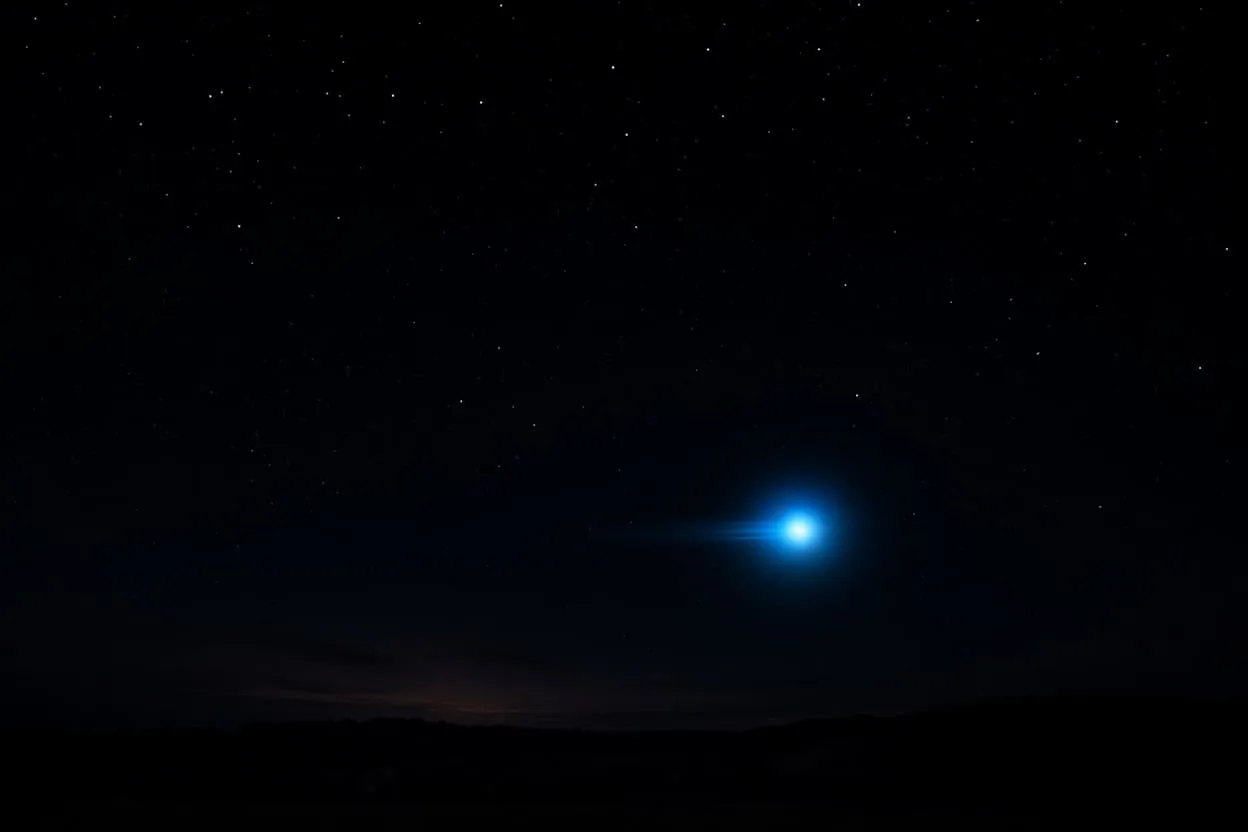
On September 12, 2026, at exactly 9:14 p.m., the sky above Les Aix-d'Angillon, a small town in the Cher department of central France, became the stage for a brief but intense phenomenon. The main witness describes a sequence in three distinct stages. First, a motionless blue point of light, smaller than a satellite. Then, almost immediately, what resembled a shooting star — except this one seemed to "explode" in the sky rather than simply fade out. Finally, emerging from the distance, a third object of indefinite shape but with a white brilliance far exceeding that of an aircraft, crossing the sky from south to west at a speed the witnesses judged well beyond that of a commercial plane.
The entire event lasted only two minutes. But the witness stresses a detail that recurs in nearly all sightings of this kind: total silence. No engine roar, no audible blast, even though the object was described as closer and faster than an airliner.
Six Witnesses, a Video Despite a Damaged Phone
Notably, this was not a lone observation but one shared by a small group of six people, including several direct neighbors, who could potentially corroborate the account independently — a detail investigators generally consider valuable, since multiple independent observers reduce the likelihood of a purely individual misperception.
The witness tried to film the scene on an iPhone 11 whose rear camera is damaged and normally struggles to capture faint, distant sources such as stars or satellites. Despite this technical limitation, the object was reportedly still recorded — a sign, some argue, of its exceptional brightness. An original video does exist, though it has not yet undergone independent authentication.
A Strikingly Methodical Sighting Report
The witness places the azimuth of the appearance at roughly 66° (northeast), with an angular elevation of about 25° above the horizon. The trajectory ran broadly from south to west before the object vanished. It is described as egg-shaped on the sighting form, though the narrative account emphasizes a diffuse, blinding white light more than any sharply defined outline — a common discrepancy between the box ticked on a form and what is actually experienced, where glare often prevents a clear silhouette from being distinguished.
The color is uniformly reported as an intense luminous white with no chromatic variation, which rules out certain leads such as ball lightning, typically associated with more orange or bluish hues. No sound was associated with the main object; only the silent "explosion" following the shooting star hints at a noise that, notably, no one actually heard.
The Cher: A Quiet Region, Not Entirely Free of Aerospace Sightings
Unlike regions such as Lorraine or the Larzac plateau, historically tied to France's major waves of sightings, the Centre-Val de Loire region has no particular reputation as a hotspot for unidentified aerospace phenomena. GEIPAN, the French space agency's dedicated study group, nonetheless logs a steady stream of reports there, as elsewhere in the country, classified on a scale from PAN A (fully explained) to PAN D (remaining unexplained after thorough investigation). The citizen-science network Vigie-Ciel, tied to the FRIPON fireball-monitoring program, also covers this part of the country. The nearby Bourges-Avord air base is another factor that serious investigators always weigh before entertaining more exotic explanations.
"It wasn't a plane, a star, or a satellite. It was faster, closer, and completely silent. I had never seen anything like it in my life."
— Account gathered from the main witness
The Scientific Angle: Fireball, Space Debris, or Optical Effect?
The three-stage sequence described by the witness — a static point, an "exploding" shooting star, then a bright object streaking by in silence — strongly evokes a bolide, the technical term for a meteor whose brightness exceeds that of the planet Venus. The Vigie-Ciel network notes that such events, while spectacular, occur several times a year across France, consistently producing very similar testimonies: intense light, apparent high speed, and no sound heard at the moment of passage — since any sound from atmospheric fragmentation can take dozens of seconds to reach the ground.
A second hypothesis worth considering is the atmospheric reentry of space debris or a batch of Starlink satellites, an increasingly common occurrence since the deployment of low-orbit megaconstellations. Such reentries typically produce a slow-moving "train" of lights, sometimes with a brighter flash as a component breaks apart. However, the brevity of the event described here — two minutes — and its clear change of direction point, according to several amateur astronomers consulted on similar cases, more toward an isolated fireball.
What Researchers Have to Say
GEIPAN's classification carefully separates explained cases (PAN A) from those that remain wholly unexplained after a full investigation (PAN D) — a category that, contrary to popular belief, has historically accounted for only a minority of cases examined. Researchers such as astrophysicist Jacques Vallée and astronomer J. Allen Hynek argued for the scientific value of this residual category of unresolved cases, seeing in it a reason to question our perceptual categories rather than evidence of extraterrestrial visitation. In this instance, the lack of expert video analysis and the still-limited number of independently gathered testimonies call for caution: at this stage, the case looks more like a report awaiting investigation than a confirmed mystery.
Grok, CC0,

0 comments: