
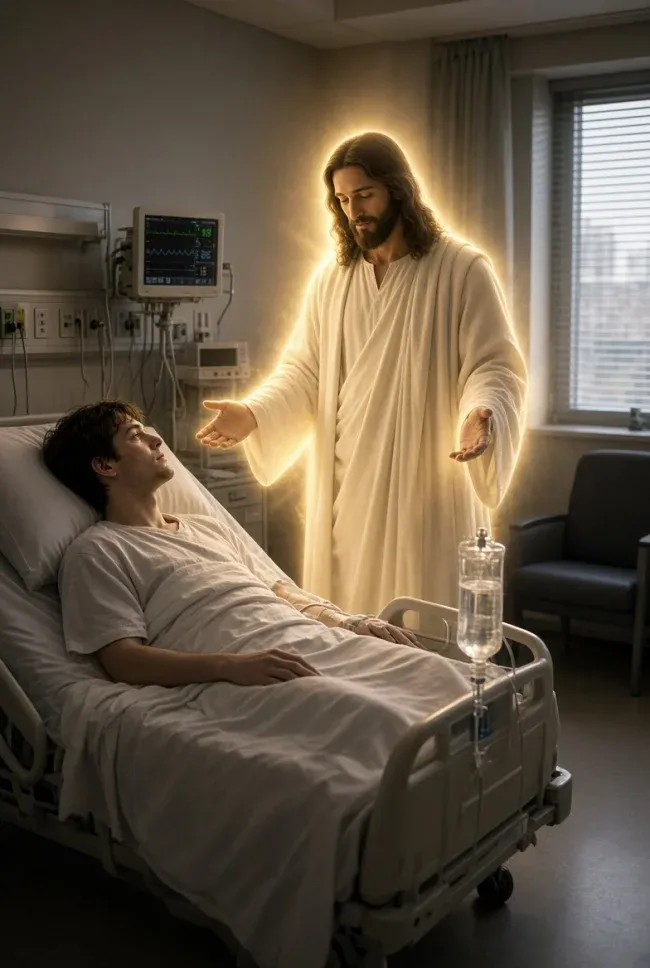
On July 6, 2024, a father in Cebu, Philippines, published a Facebook post that would go on to be shared worldwide, circulating for two years across TikTok, X (formerly Twitter) and countless evangelical pages before resurfacing periodically in social media feeds. Joel Sia recounted the final moments of his son Jonathan, a 23-year-old student at the University of San Carlos in Cebu, who died one week before he was due to graduate Magna Cum Laude in Business Administration.
According to the father's account, since widely repeated, Jonathan had been hospitalized with a kidney disorder. Intubated as his condition worsened, he reportedly lost the ability to speak. In his final moments, he is said to have gestured toward his father as though he could see a presence in the room. Joel Sia says he handed him a pen and paper. Though extremely weak and trembling, the young man reportedly managed to write, in what his father described as perfectly legible handwriting, three words: "Jesus is real." Seconds later, he is said to have gone into cardiac arrest. His mother, at his bedside, says she saw a light and a hand lifting her son as he passed, a smile on his face.
A young man remembered for his faith
Jonathan Sia's relatives, quoted in the numerous social media retellings of the story, describe him as a young man of deep faith since childhood, nicknamed a "prayer warrior" by those close to him, who reportedly kept speaking about his faith to hospital staff even from his bed. A high-achieving student, he was about to graduate with honors when his health suddenly deteriorated.
It is this trajectory — the promise of a bright future, publicly professed religious devotion, and the suddenness of the kidney illness — that fueled the story's virality, elevating it through countless shares into a "testimony" and, for a significant portion of the English-speaking evangelical public and beyond, empirical proof of God's existence.
Reconstruction of the message shared by the family
What follows is a reconstruction, based on the consistent versions circulating publicly, of the testimony originally posted by Joel Sia on social media. It is not an official document but an illustrative synthesis of the reported statements.
"Before my son Jonathan was resuscitated, he signaled to me as though he was seeing someone, but I couldn't understand what he was trying to tell me. So I gave him a piece of paper and a pen so he could write it down. He was already very weak, shaking, barely able to hold the pen. Yet before the nurses called a Code Blue, he managed to write one final message: 'Jesus is Real.' It amazed me, because the words were so clearly legible. I believe he saw Jesus. My wife Aidy also witnessed a bright light and a hand lifting our son as he ascended. He was smiling."
"He could no longer speak because of the intubation. Yet in a matter of seconds, he traced three perfectly legible words." — Joel Sia, Jonathan's father
Terminal lucidity: a phenomenon documented by medicine
Jonathan Sia's case falls into a category of phenomena the medical literature calls "terminal lucidity," or paradoxical end-of-life lucidity. German psychiatrist Michael Nahm and Bruce Greyson, professor emeritus of psychiatry at the University of Virginia and a leading researcher on near-death experiences, have published several studies cataloguing cases of patients with advanced dementia, deep comas, or prolonged agonal states who unexpectedly regain mental clarity and the ability to communicate in the hours before death — a state seemingly at odds with their clinical condition.
This resurgence remains poorly understood physiologically. Proposed hypotheses include terminal neural discharges, sudden shifts in cerebral oxygenation, or a transient redistribution of cortical activity in the process of dying. None of these has achieved scientific consensus, and the rarity of the phenomenon — difficult to document in real time in an intensive care setting — severely limits the possibility of rigorous clinical study.
End-of-life visions as a research field in their own right
Alongside terminal lucidity, "end-of-life visions" or "deathbed visions" form a distinct field of research, notably explored by British neuropsychiatrist Peter Fenwick, whose studies examine perceptions reported by hospice patients. His work shows that dying patients frequently report perceiving presences, deceased relatives, or religious figures in the hours before death, regardless of their culture or prior beliefs.
Explanations proposed by the scientific community center mainly on neurological mechanisms: cerebral hypoxia, hypercapnia (carbon dioxide buildup in the blood), the release of neurotransmitters such as serotonin or dopamine during the dying process, and residual activity in the visual cortex in the absence of external stimulation. These mechanisms are documented in various clinical contexts, notably cardiac arrest, and have been studied extensively by American cardiologist Sam Parnia as part of the AWARE research program on consciousness after cardiac arrest.
What critical analysis of the account calls into question
Beyond the medical framework, several elements specific to this testimony's viral spread call for journalistic caution. First, no independently verifiable primary source — a medical record, a hospital statement, or a Filipino press article contemporaneous with the events — could be located beyond the social media posts and their successive reshares. The account rests entirely on the father's testimony, relayed second- or third-hand by faith-based accounts aimed at edification, a format that structurally favors the homogenization and embellishment of a story as it spreads.
Second, the versions of the testimony recorded over its spread show minor but notable variations: the exact nature of the kidney condition, the precise wording attributed to the father, and the description of the "hand" perceived by the mother all differ from one retelling to another — a classic sign of an oral or semi-oral account that sediments and dramatizes with each new transmission, a phenomenon folklorists know as narrative chain drift.
Finally, on a clinical level, the fine motor control required to write three legible words as an intubated patient in terminal multi-organ failure remains a rare but not impossible event: it precisely matches the clinical definition of terminal lucidity discussed above, without in itself constituting proof of the nature of the patient's subjective experience at that moment.
A phenomenon that extends beyond religious framing
It is worth noting that this type of testimony is not unique to evangelical Christianity. Researchers such as Icelandic psychologist Erlendur Haraldsson and American anthropologist Karlis Osis have documented similar end-of-life visions among Hindu, Buddhist, and non-religious patients, each perceiving figures consistent with their own cultural and symbolic framework — a point that proponents of a universal neurological explanation cite in their favor, while proponents of a transcendent explanation instead read it as evidence of a genuine experience simply translated into the language of each culture.
Conclusion: between neurology and transcendence
Jonathan Sia's case illustrates the persistent difficulty, given the current state of knowledge, of choosing between a strictly neurophysiological explanation of end-of-life phenomena and the transcendent interpretation defended by the families and faith communities involved. Neither mainstream medicine nor academic parapsychology currently offers a definitive explanatory framework for this type of episode — documented for centuries across every culture, yet whose rigorous scientific study remains, by its very nature, hampered by the unique, unpredictable, and non-reproducible character of each case.
Grok, CC0,

0 comments: