2026-11-27

Croglin Grange: The Cumbrian Vampire, Between Family Legend and Victorian Fiction

Croglin Grange: The Cumbrian Vampire, Between Family Legend and Victorian Fiction

A forced window, a bite on the neck, a ransacked vault: the tale of the "Croglin vampire" is the most famous in England. But does its house exist, and its church?

A Lost Village at the Edge of Cumberland

Croglin is a tiny hamlet in the former county of Cumberland, now part of Cumbria in north-west England. Nothing destined it for posterity. Yet its name appears in every anthology of British supernatural lore, thanks to a story that fits in a few pages: that of a young woman attacked in her bedroom, on two summer nights a year apart, by a creature that tradition eventually labelled a "vampire".

The tale has remained attached to a dwelling, Croglin Grange, which is today identified with Croglin Low Hall, an isolated farm less than three kilometres from the village. Legend has it that the events date back to the period following the English Civil War, in the 1650s. The Fisher family, owners of the place, are said to have passed the story down from generation to generation, until one of their descendants told it to a man of letters in 1896.

Augustus Hare and Captain Fisher

That man of letters was Augustus Hare (1834-1903). A travel writer, biographer and sought-after raconteur of Victorian high society, he devoted six volumes to his own life, published in two waves between 1896 and 1900 under the title The Story of My Life. In it he reports, in all seriousness, a tale heard from a certain Captain Fisher, identified by other sources as Edward Fisher-Rowe.

Hare places the conversation at a dinner in 1874. His companion, having just listened to him reel off one ghost story after another, replied that his own family possessed an even stranger one. The Fishers, he said, had for centuries occupied an old estate in Cumberland called Croglin Grange. Having outgrown it, the family had moved to the south of England, near Guildford, and let the property to tenants.

What the Account Says

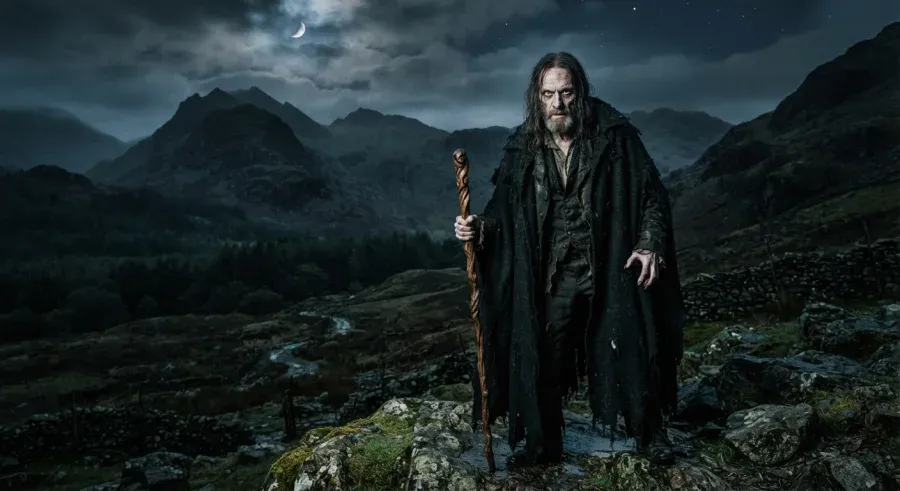
According to Hare, the new occupants were siblings: a sister, Amelia, and her two brothers, of the Cranswell family. The house was single-storey, its bedrooms looked onto a lawn, and beyond it lay a graveyard. On a stifling summer evening, the windows were left open. Amelia, unable to sleep, saw two points of light advancing through the night. They were the eyes of a figure with a brown, shrivelled, mummified-looking face. The creature popped out a pane of glass by working at the lead, climbed into the room and bit the young woman on the neck. Her screams alerted her brothers, and the attacker fled.

The victim recovered, travelled, then returned the following year. The attack was repeated. This time the brothers were armed. One of them fired and hit the assailant in the leg. The creature made for the graveyard and vanished into a vault. The next day the villagers watched the crypt being opened: the coffins were smashed and their contents scattered, except for one, whose lid was merely lifted. Inside lay a desiccated, intact body bearing the gunshot wound. The body was burned, and the vampire was never heard of again.

A House That Does Not Exist… Or Almost

This is where the investigation begins. From the early twentieth century, the curious went to the spot and found no house called Croglin Grange. The author Charles G. Harper, in Haunted Houses (1907), noted the absence of that name, but found two neighbouring buildings, Croglin High Hall and Croglin Low Hall. The occultist Montague Summers, a staunch defender of the story, argued that Low Hall matched the description and that Hare may have recorded the name wrongly.

Later research partly reinforces this hypothesis. Property deeds indicate that, until 1720, Croglin Low Hall was sometimes called Croglin Grange. In 1963, the journalist F. Clive-Ross discovered that the story was known to the entire village. The tenant of the property even showed him the window through which the vampire was said to have entered, and descendants of the Fishers were still living in the area. In 2005, Richard Whittington-Egan unearthed the rental records: the Fisher family took the lease on Low Hall in 1809.

The Missing Graveyard

The most awkward point remains: no church or vault exists today near Low Hall. Yet a map by Robert Morden dated 1695 shows "Crogling Parva" at that location with, right beside it, a "Crogling Church". According to tradition, this building was destroyed during the Wars of the Three Kingdoms (1638-1651), which would fit a legend born in the 1650s. The church's presence on a 1695 map, however, casts doubt on that chronology. Its stones are said to have been reused in other buildings, and almost nothing of it remains.

The Sceptical Analysis: A Tale With No Echo Before 1874

Sceptics raise several objections. First, the story left no written trace before the 1874 conversation. Researcher Geoff Holder, who devoted a chapter of Paranormal Cumbria (2012) to it, combed the works of Cumbrian folklore published between 1874 and 1900 without finding the slightest mention. For an episode as spectacular as a vampire burned in front of an entire village, this silence seems weighty, especially as the event should logically have left a mark in the local press.

Second, vampirism has little place in traditional English folklore. The Croglin story predates the publication of Dracula (1897) by more than twenty years, which its defenders cite as an argument for its priority, but several commentators see similarities with Varney the Vampire, a hit serial of the 1840s whose nocturnal intrusion scene strongly recalls the one at Croglin.

Third lead: the mischievous captain. The British magazine The Skeptic has suggested that Fisher was no liar, but a man with a robust sense of humour, who served a credulous storyteller a tale invented for the occasion. Brian Dunning, of the Skeptoid podcast, goes further: he sees a fabricated or embellished story, of which Hare would be the source, and which the twentieth-century Fishers eventually came to believe was a long-standing tradition. He admits nonetheless that an intruder could have entered a tenant's bedroom one evening without that making a vampire.

What Can Be Said With Certainty

The solid facts are thin. A Captain Fisher did tell this story to Hare in 1874. A house called Croglin Low Hall exists, which was called Croglin Grange before 1720, and the Fisher family was its tenant. A neighbouring church did exist, then disappeared. As for the attacks, the vault and the burned body, nothing attests to them outside Hare's account. The file thus oscillates between genuine local tradition and Victorian fiction skilfully rooted in a real place. It is precisely this mixture that explains its longevity: enough truth to unsettle, enough vagueness to resist any verification.

Légende - Photo
Gemini, CC0,
Sources
TagsVampire, Cryptozoology

2026-11-22

Yankee Pedlar Inn: The Haunted Connecticut Hotel Where Alice Conley Still "Watches Over" Her Guests

Yankee Pedlar Inn: The Haunted Connecticut Hotel Where Alice Conley Still "Watches Over" Her Guests

Room 353, a rocking chair that moves by itself, a horror film shot on location and a building left to decay: the Torrington inn combines ghost legends with a real-estate saga.

An 1891 Inn in the Heart of New England

At 93 Main Street, on the corner of Maiden Lane, the brick silhouette of the Yankee Pedlar Inn still looms over downtown Torrington. The establishment was built in 1891 for Frank and Alice Conley in a New England colonial style. Frank was an immigrant from Ireland; Alice was a native of New England. She managed the hotel while he ran the operation, and the business stayed in the family for many years.

It was then called the Conley Hotel. It only took its current name in 1956, when the hotel was merged with the neighboring restaurant. For a long time it was among the oldest independent hotels in Connecticut still in operation, with 52 rooms.

Alice Conley, the Landlady Who Never Left

According to tradition, Alice Conley died in the hotel, in room 353 – some sources give the year 1910, with no supporting document in the texts consulted. Her skills as a manager and cook are said to have made the place a success. And it is precisely this concern for her customers that, according to ghost-story enthusiasts, would explain her lingering presence: she is supposedly making sure everyone enjoys their stay.

"Alice still watches over her guests" – the local legend, as reported by American haunted-places websites.

What Witnesses Report

The accounts center on a few specific points. In room 353, visitors report apparitions, unexplained smells and noises at night. In the lobby, Alice's rocking chair is said to rock with nobody in it, to the point that a sign discouraged guests from sitting in it, as the website Damned Connecticut reports.

Other places are mentioned. Room 295 is said to be the scene of moving objects, noises and a diffuse unease; the apparition of Frank Conley is reported there. A haunted-rooms website also mentions, in the Adelaide Room, a woman accompanied by her two children. A visitor quoted by Damned Connecticut says she found 353 locked, then open ten minutes later, and felt chills on entering. These are isolated accounts, with no recording or expert examination.

"The Innkeepers": When Cinema Joins the Legend

The reputation of the place attracted director Ti West, who shot his 2011 horror film The Innkeepers there. The screenplay, built around the phenomena attributed to the inn, follows the last two employees of a hotel about to close (Sara Paxton and Pat Healy), who dabble in ghost hunting. Among the guests is a former actress turned medium (Kelly McGillis), while an old man insists on staying in room 353 – a direct nod to the legend.

The shoot itself fed the rumor: during production, the website Bloody Disgusting joked about a set photograph in which a bright dot looked like an "orb"; its writer leaned instead toward dust or a flashlight reflection on the lens. The New York Times (Tammy La Gorce, 2014) and Steve Dollar (2012), for their part, mentioned the link between the film and the establishment's reputation.

From Hotel to Abandoned Building

The irony of history: the film imagined the closing of a hotel that was about to really close. The inn ceased operating on December 1, 2015, for renovations that were supposed to take seven to nine months. The work stalled for lack of funds, the establishment never reopened, and the City of Torrington had to take legal action against the owner, Jayson Hospitality, which had gutted the building after acquiring it.

Since then, the City has entrusted the case to the Torrington Development Corporation under a receivership procedure provided for by Connecticut law (examined as early as January 2021). In December 2024, Governor Ned Lamont announced a $200,000 grant to assess the 1.62-acre site. In April 2026, the city council again voted a reduced allocation of up to $40,000 for the same development corporation. The building's final fate remains open.

The Skeptical View

Several elements call for caution. The accounts about room 353 come largely from haunted-places websites and blogs, whose sources copy one another; the place's Wikipedia page is itself flagged as lacking references. No published independent investigation establishes an objective phenomenon, and the date and circumstances of Alice Conley's death are not documented in the texts consulted.

Above all, psychology offers classic explanations. The work of Richard Wiseman and his colleagues (British Journal of Psychology, 2003) on reputedly haunted sites showed that impressions of a presence depend largely on suggestion: forewarned visitors report sensations in the places the legend points to. The physicist Vic Tandy, for his part, proposed in 1998 that infrasound could cause unease and fleeting visions. An old building, its drafts, its creaks and a reputation manufactured by a film are enough to sustain the myth, without any need to summon a spirit.

A Legend That Outlives the Walls

Whether or not one believes in Alice Conley's presence, the Yankee Pedlar Inn illustrates a mechanism well known to folklore researchers: a place steeped in history, a devoted landlady figure, a few precise details (a room number, a chair), and the legend is passed down from generation to generation. It even ended up inspiring a film, which in turn strengthens the reputation of the place. It remains to be seen whether the building will ever reopen its doors – and whether Alice, in that case, will resume her post.

Légende - Photo
Doncram, CC BY-SA 3.0, https://commons.wikimedia.org/wiki/Special:Redirect/page/9425823
Sources
TagsHaunted house

2026-11-20

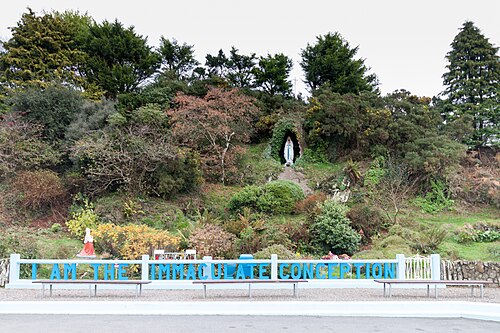
Ballinspittle, 1985: The Day a Concrete Virgin Began to Move

Ballinspittle, 1985: The Day a Concrete Virgin Began to Move

Statues of the Virgin Mary said to possess strange properties are not in short supply around the world. Most of them stop at weeping, sometimes bleeding. One in a small village in County Cork, Ireland, went much further during the summer of 1985: it was said to move on its own. Forty years on, the phenomenon still divides believers, psychologists and historians.

A Village of 200 Souls, a Grotto and Eleven Light Bulbs

Ballinspittle then had about 200 inhabitants, between the seaside town of Kinsale and Garretstown. On a hillside, a grotto housed a statue erected for the Marian Year, lit by a halo of eleven electric lamps. The whole structure dated from 1954, and the statue itself was made of concrete. Its maker later recalled that the hands had been reinforced with wire. Nothing about this ordinary object of devotion hinted at an international destiny.

Late July 1985: The First Accounts

Accounts differ as to who the first witnesses were. The Irish Times reports that two women out for a walk near the grotto saw the statue move. An encyclopedia of the paranormal speaks instead of two teenage girls. A local resident, Catherine O'Mahony, says for her part that children claimed to have seen the statue move after the recitation of the rosary. These versions are not necessarily contradictory, but they show how quickly, and through how many voices, the legend took shape.

What followed is better documented. The next evening, forty villagers came to check for themselves, and all of them said they had seen the statue move. Soon almost the entire village claimed to have witnessed the marvel.

The Rush: Tens of Thousands of Pilgrims

The rumor spread at remarkable speed. The following Tuesday, a thousand visitors arrived. By the end of the first week, the railway company CIE was running special services, eighty volunteer stewards were managing the site, and attendance averaged 10,000 people a night. A report by Irish television broadcaster RTÉ, aired on 31 July, described some 8,000 people gathered, a round-the-clock vigil and a local committee set up to handle the influx.

On 15 August, the Feast of the Assumption, thousands of the faithful crowded in front of the grotto. In all, as many as 100,000 people are said to have descended on the village between late July and August. American, British and Australian media relayed the story.

The Epidemic of Moving Statues

Ballinspittle did not remain an isolated case. Similar phenomena were reported almost immediately in Dunmanway and Courtmacsherry. The first claims of this kind had appeared in Asdee, in County Kerry, and in Ballinspittle. By the end of the summer, Marian apparitions were being reported from Sligo to Kerry, and as far as Kilkenny and Waterford. In September, a Sunday newspaper even published a map of Ireland marking 28 sites. 1985 went down in Irish memory as "the year of the moving statues."

Some pilgrims also reported healings. On 31 July, a Cork woman who had been deaf since the age of twenty claimed to have regained her hearing during a visit to the grotto.

The Church Keeps Its Distance

The Catholic hierarchy reacted with great caution. Bishop Michael Murphy of Cork and Ross called for "common sense" and announced that he would not visit the grotto, for fear that his visit would be taken as an endorsement. He nonetheless admitted that he welcomed the sight of crowds gathering in a great spirit of fervor. One bishop eventually described the whole affair as a mere illusion. Years later, a resident claimed that the local clergy had always preferred to look the other way.

Psychologists Offer Their Explanation

The Department of Applied Psychology at University College Cork investigated. Its researchers concluded that it was an optical illusion, which they dubbed the "Ballinspittle Phenomenon." Their main argument concerned light: the statue only seemed to move as night fell. They also pointed out that people sway slightly when standing still for a long time, which makes the object they are staring at seem to move. The team recorded 31 apparition sites across the country.

Psychologist Peter Davison argued, in an RTÉ report, that the shimmering of the statues was due to the autokinetic effect. This well-known phenomenon makes a stationary point of light appear to move when viewed in darkness. Other hypotheses circulated at the time, including mass hypnosis among people ready to see the statue move, or a poor tourist season fueling the movement. A more recent observer has placed the episode in an Ireland whose historic bond with the Catholic Church was beginning to change.

What the Witnesses Say

Believers are not convinced. A witness quoted by the Irish Examiner says that in July 1985 she saw the concrete statue float in mid-air. Another replies that light could not explain why the face changes appearance. Catherine O'Mahony, now a member of the grotto committee, saw the statue move six weeks after her first sighting, then several more times, most recently in August of the year she gave her account. She says she still receives letters from people asking her to pray for them at the grotto.

A Site Still Alive

The phenomenon faded fairly quickly, but a few small circles of devotees persisted for several years. The statue was even vandalized: attackers armed with hammers damaged it, and it was then repaired. Pilgrims have continued to gather there since it was put back in place. The upkeep of the grotto relies on a committee and a genuine community effort.

Collective illusion or miracle? The two readings have lived side by side since 1985, and neither has managed to erase the other. The optical explanation is solid and widely accepted, but it has never extinguished the conviction of those who say they saw the Virgin move. At Ballinspittle, the question remains open for the witnesses themselves.

Légende - Photo
Toastydave, CC BY-SA 4.0, https://commons.wikimedia.org/wiki/Special:Redirect/page/57341202
Sources
TagsMarian apparition

2026-11-15

Afghanistan: When Marines Met a Djinn in a Classroom

Afghanistan: When Marines Met a Djinn in a Classroom

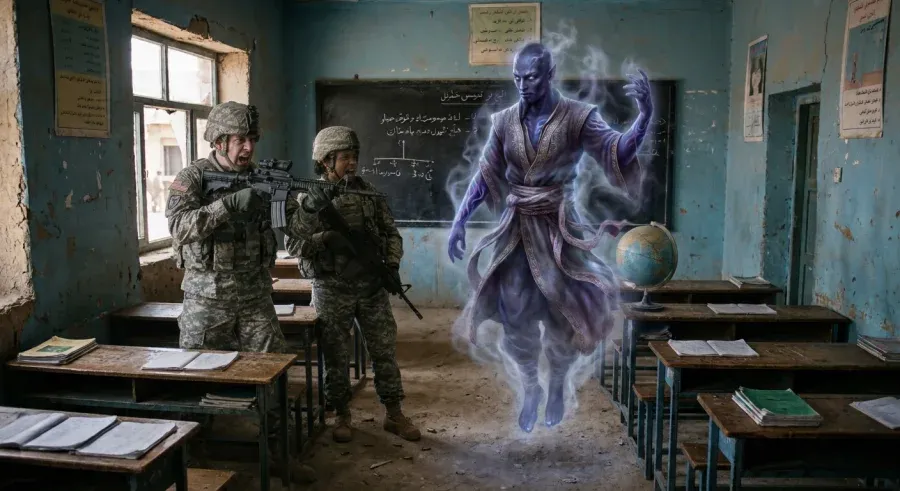
In southern Afghanistan, American soldiers say a classroom “came alive” around them. Questioned the next day, a local mullah spoke not of a ghost but of a djinn. An investigation into a region where two imaginations of the invisible collided.

A School, a Wall, a Night

As is often the case, the story begins with a rumor. A group of Marines assigned to guard a school near Amir Aghah learn from residents that teachers were allegedly murdered there during Taliban rule. Nothing known about the region makes the claim implausible: southeastern Afghanistan has endured four decades of war, reprisals and massacres.

One night, the troops spot movement near the perimeter wall. They secure the area and clear the compound. It is in a classroom, they say, that everything tips over: a desk falls and moves across the floor. A window shatters. No obvious cause is found.

“It Is Not a Ghost”

The next day, the Marines question a local mullah. His answer is not the one Westerners expect. He speaks neither of the restless souls of dead teachers nor of revenants: he speaks of a djinn.

In Islamic tradition, djinn are beings from an invisible realm that theology calls al-ghaib, “the unseen.” They share our universe without being perceived, and can intervene in human lives for good or ill. An apparition is therefore not the soul of the dead here, but a presence of another nature.

According to the Marines, the activity did not stop with this explanation. Furniture kept moving. Apparitions were reported. Several service members said they had the same dream: being chased by a dark figure.

Everyone interprets the unexplained with the words their culture puts at their disposal.

Amir Agha, Land Both Sacred and Cursed

To understand the mullah’s reaction, one must know the place. The locality of Amir Agha, in Garmsir district (Helmand province), takes its name from a protective saint. A small shrine there is dedicated to Amir Hamza, presented by local tradition as an uncle of the Prophet and one of his most faithful commanders, as well as to one of his descendants, Amir Agha. His tomb is said to lie beneath the building.

For residents, this place protects. A mullah’s son from Garmsir told journalists that Soviet armored vehicles sent against the shrine got stuck in the mud, and that in 1982 a rocket fired at the roof allegedly vanished before reaching the tomb, then exited through a window. The rusting wrecks still lie across the region.

The shrine’s caretaker gives a darker reading of the American presence: according to him, soldiers came several times at night, forced villagers to stay indoors and took precious marble tablets inscribed with Quranic verses. A desecration, he says, that set a curse in motion. It should be stressed that this is his account, not an established fact.

OP Rock: The Hill of Bones

The same area produced the most famous military paranormal story of the war in Afghanistan: that of Observation Post Rock, known as “OP Rock,” a few hundred meters from Patrol Base Hassan Abad. It is a mound of roughly one hundred feet, riddled with collapsed tunnels and likely developed by the Taliban.

When Marines and British soldiers dug their positions there, they unearthed bones in large quantities. Residents explain that the hill has served as a burial ground for centuries and was also the scene of massacres during the Soviet-Afghan war of the 1980s.

The testimonies that followed have become a classic of the genre: lights resembling muzzle flashes without any gunfire, radio static, sudden temperature changes, serial nightmares, sleep paralysis, the feeling of being watched. One Marine reports hearing, in his ear, a whisper in Russian meaning roughly “drop your weapon.” Even the dog the soldiers had adopted, named “Ugly Betty,” barked at figures no one could see.

The affair was relayed by The New York Times (an article by Thomas Gibbons-Neff, published in late October 2020) and adapted in the American series Paranormal Witness (season 4, episode “Beneath the Rock”). One Marine saw the place as a “conduit” for paranormal activity.

One caveat is in order: the Amir Aghah school account and OP Rock are two distinct episodes, even though they occur in the same area. Lacking a date, a unit or an official report, we have been unable to corroborate the desk incident with an independent document. For now, it rests on the testimony of the service members.

Summary File — Reconstruction (Sourced Facts Only)

File: phenomena reported by Western service members, Amir Agha area (Garmsir, Helmand)
Document status: editorial summary, not an official document
Reported elements (Amir Aghah school): nighttime movement near the wall; overturned desk; broken window; moved furniture; apparitions; recurring dreams of a dark figure.
Local interpretation: a mullah suggests a djinn.
Documented elements (OP Rock): bones discovered during earthworks; lights, radio static, temperature variations, nightmares; coverage by The New York Times in 2020.
Unestablished elements: cause of the broken window and moved furniture; reality of the murders of teachers at the school; effect of any “curse” of the shrine.

Two Grammars of the Invisible

This is where these stories become inseparable from place. An American soldier arrives with his own cultural baggage: the ghost, the haunted house, the dead who return, fed by cinema and barracks legends. An Afghan community has another vocabulary: protective saints, sacred places, spirits, djinn. A troubling event is then read by both sides, each in its own language.

The encounter is sometimes explosive. In Amir Agha’s case, the same place is seen as a haunted graveyard by the Marines, as a protective shrine by the villagers and as outraged ground by its caretaker. As Atlas Obscura sums it up, one culture’s vengeful spirit is another’s guardian angel.

The Critical View: Stress, Priming, Suggestion

Skeptics have serious arguments. First, the conditions: isolation, fatigue, lack of sleep, constant tension, buildings gutted by years of fighting. A desk that tips over or a window that shatters in a weakened structure can have mundane causes (wind, settling, an animal, even a human presence), especially as the troops had just spotted movement near the wall.

Then there are the dreams of being chased by a shadow. They recall sleep paralysis, studied notably by folklorist David Hufford in The Terror That Comes in the Night (1982), which shows that the experience of a menacing presence in the bedroom appears in many cultures, with local dressing. Sleeping in groups and recounting one’s nights is enough to spread the same motif.

Finally, psychiatrist Anthony Feinstein (University of Toronto), a specialist in the psychological effects of conflict, explains regarding OP Rock that hallucinations are not in themselves a symptom of post-traumatic stress, but that traumatized people can dissociate and experience abnormal perceptions. Above all, he describes a mechanism of priming: a few soldiers have a strange experience and recount it, and those who follow arrive expecting something to happen. Cut off from the rest of the world, with no outside “reality check,” they reinforce the belief. He compares the phenomenon to the expectations surrounding places of miracles such as Lourdes. He stresses, however, that he cannot make any diagnosis without examining a patient.

This also applies to the mullah’s explanation. Once the word “djinn” is spoken, it becomes a frame for interpreting what follows: a moving piece of furniture, a dream, a shadow. The explanation may have shaped the experience as much as the reverse.

What Can, and Cannot, Be Asserted

What happened in that classroom? We do not know. The Marines are sincere, but sincerity is not proof. The mullah applies a respectable reading, consistent with his tradition, but it cannot be verified. And the psychology of combat, while it offers solid leads, does not explain every detail of an account for which we lack the full file.

One lesson remains: in wartime, men from two worlds shared the same place and each searched for words for a common unease. Perhaps they were all confronted with something none of them understood, and simply drew on the cultural vocabulary available to them. In this region of the “graveyard of empires,” the boundary between history, memory and the supernatural remains extremely thin.

Légende - Photo
Gemini, CC0,
Sources
TagsHaunted house

2026-11-11

In 1986, an Italian teenager was miraculously healed by the Virgin Mary in Italy.

In 1986, an Italian teenager was miraculously healed by the Virgin Mary in Italy.

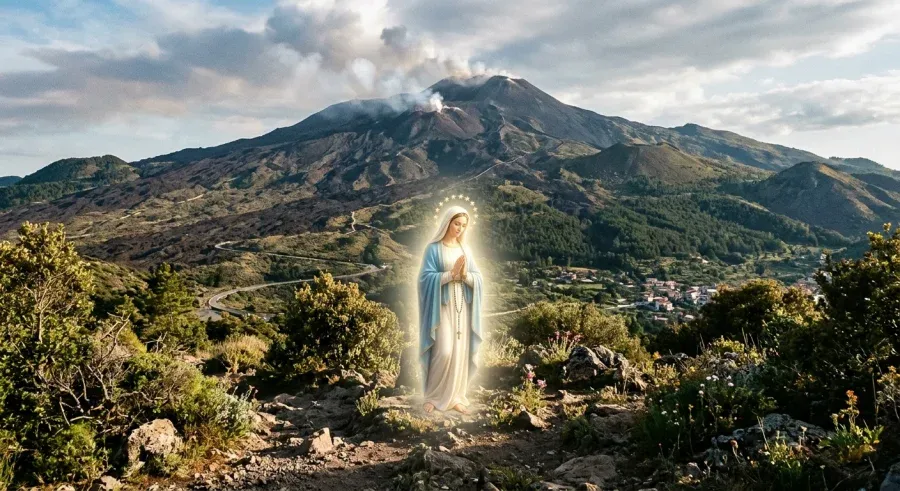
Sicily, 1986: a fifteen-year-old schoolboy, bedridden with fever, sees a light fill his room, then meets on a rock at the foot of Mount Etna the woman who introduces herself as the Virgin Mary. Thirty-three apparitions later, the Archdiocese of Catania has built a shrine on the spot. A look back at one of Italy's quietest, and most enduring, Marian cases.

A fever, a light, a voice

It all begins on 4 May 1986. Rosario Toscano, a schoolboy born in Catania in 1971 into a well-off family, is bedridden with a high viral fever. According to the account gathered by the Marian encyclopedia Marie de Nazareth, an intense light suddenly appears in his bedroom and a woman's voice urges him to pray for sinners and not to despair of his illness. The teenager asks who is speaking. The voice answers that it will say so "when the time comes."

The next day, the light returns and the voice reveals itself: "I am Mary, the Mother of God, the Immaculate Conception." She then gives him a precise appointment: Sunday 11 May 1986, at the "Borello rock," a rocky outcrop in Belpasso that the boy knows well.

The appointment at the Borello rock

On 11 May, around 4 p.m., Rosario goes there. In his journal he describes a small white cloud rapidly approaching the rock, unfolding "like a flower" and radiating the same light as in his room. A young woman then appears, dressed in white, a white cloak over her shoulders, her head encircled with gold, a veil embroidered with gold, her hands clasped around a rose. She looks less than eighteen years old.

It is here that, in the tradition reported by Catholic sources, the young man's healing takes place: the boy who had been urged not to despair of his illness comes out of this sequence restored to health. The sources we consulted, however, publish no medical file: the healing is told within the visionary's own account and is not backed by an accessible clinical assessment.

Thirty-three apparitions in two years

The encounters continue until 1 May 1988, the first day of the Marian month. During the thirty-second, the Virgin announces her thirty-third and last apparition "for an indefinite time." That day Rosario notes in his journal a state of mind identical to the previous occasions, together with a form of consolation despite the announced departure.

That same evening, according to the account, he feels a sharp pain in his chest, like a great fire in his heart. The family doctor, called urgently, gives him drops that have no effect on the sensation of heat, which is not painful but brings, he says, an inexpressible pleasure and comfort, similar to what he felt on 19 June 1986, when Mary reportedly showed him her Immaculate Heart. The visionary says he has felt the presence of this fire ever since and receives "interior locutions," a kind of dialogue of inspiration and guidance.

"I will not come back, but I am not abandoning you"

The last reported words, which Rosario says he understood on the evening of 1 May 1988: "I will not come back, but it doesn't mean that I am abandoning you. My heart will always be with you."

The visionary also mentions twelve secret messages entrusted by the Virgin: two concerning him personally and ten about the future of humanity. Their content has not been made public in the sources we were able to consult. The central theme of the public messages remains classic: praying the rosary, conversion, prayer to the angels. One message attributed to the Virgin thus invites people to pray to the angels, who "fight evil."

Messages free of doctrinal error, a benevolent archdiocese

This is what sets Belpasso apart from many controversial cases: the Virgin of Belpasso presents herself under the dogmatic titles of Immaculate Conception and Mother of God, two truths of Catholic faith, and her reported words have, according to Catholic sources, raised no doctrinal objection. The Archdiocese of Catania has accompanied the phenomenon rather than holding it back.

On 1 May 2000, Mgr Luigi Bommarito, then Archbishop of Catania, blessed the statue of the Madonna of the Belpasso rock and consecrated the chapel built, according to the wish attributed to the Virgin, on the site of the apparition. He made it a diocesan Marian shrine and attached the Jubilee indulgence to it. Interviewed by the Italian Catholic monthly Jesus, he described Rosario as a balanced, serene boy who does not seek to draw attention to himself. On 11 May 2011, Archbishop Salvatore Gristina declared, during the solemn Mass at the rock, that the Church would study the Virgin's messages in order to understand them better and for the edification of the faithful.

From the rock to the shrine: pilgrims by the thousands

The crowds came quickly. Between 1986 and 1988, an estimated 150,000 pilgrims came to Belpasso. Today, the Shrine of the Madonna of the Rock, on the heights of the town, still hosts a pilgrimage on the first day of every month that gathers, according to Catholic sources, more than 3,000 people.

The file also includes its share of reported atmospheric phenomena: the white cloud of the first apparition, then, on 11 May 1990, a large cross seen in the sky by many people. Mgr Bommarito himself reportedly acknowledged that a cloud above Belpasso had taken on an inexplicable shape, according to an excerpt published by the platform "A Moment with Mary."

Archive file: what the sources say

Summary document compiled by the editorial staff from the sources cited below (no period document is reproduced).

  • 04/05/1986: Rosario Toscano, a schoolboy from Catania born in 1971, is bedridden with a viral fever. First light and first voice in his bedroom.
  • 05/05/1986: the voice introduces herself: "Mary, Mother of God, the Immaculate Conception." She sets an appointment at the Borello rock.
  • 11/05/1986: first apparition, around 4 p.m., after the arrival of a luminous white cloud.
  • 19/06/1986: apparition during which Mary reportedly showed him her Immaculate Heart.
  • 01/05/1988: thirty-third and last apparition, announced during the thirty-second. Sensation of a "fire in the heart" that same evening.
  • 11/05/1990: a large cross seen in the sky over Belpasso by many people.
  • 01/05/2000: blessing of the statue and consecration of the chapel by Mgr Bommarito; diocesan Marian shrine.
  • 11/05/2011: Mgr Gristina announces the Church's study of the messages.

A critical eye: what can be said, and what cannot be claimed

First, the Church status of the case must be gauged correctly. According to the sources consulted, Belpasso is a diocesan shrine blessed by the archbishop, which amounts to pastoral recognition. We found no formal declaration of "supernaturality" of the apparitions, and in any case the Church no longer issues one as a general rule: the new Norms of the Dicastery for the Doctrine of the Faith, published on 17 May 2024, provide for six possible conclusions, from nihil obstat ("nothing stands in the way") to a declaration of non-supernaturality, and specify that even a nihil obstat expresses no certainty about the supernatural authenticity of the phenomenon.

On the facts, three points call for caution. First: the "lightning-fast healing." A viral fever in a teenager resolves spontaneously within a few days in the vast majority of cases; without a medical file, nothing allows one to tell a natural course from an exceptional event. Second: the main source of the story is the visionary himself, through his journal, relayed by devotional publications. The historian Marc Hallet, author of Les apparitions de la Vierge et la critique historique, points out that the overwhelming majority of books on Marian apparitions are written by authors who believe in them on principle, which calls for cross-checking sources. Third: the luminous perceptions and figures seen by a feverish teenager, then in a climate of growing fervor, fall under well-known mechanisms of suggestion, collective expectation and religious interpretation of atmospheric phenomena; the 1990 cross, seen by many witnesses, may stem from the same processes, or from a cloud effect.

On the other hand, the harshest critics have little purchase on one point: no scandal, no request for money, no heterodox message has been reported to date in our sources. The visionary is described as discreet by his own bishops. This is the opposite of many cases marked by conflicts with the hierarchy.

An echo of Beauraing

The number thirty-three is reminiscent of the thirty-three apparitions of Beauraing (Belgium), which occurred in 1932-1933 to five children, before recognition by the Bishop of Namur. Numerical coincidence or repetition of a narrative pattern, the question remains open; it illustrates in any case the symbolic strength of the number thirty-three in the Christian imagination, that of the years of Christ's life according to tradition.

What to remember

At Belpasso: no controversy, a shrine, faithful pilgrims and a visionary who has remained discreet. For believers, one more sign of the Virgin's benevolence; for researchers, a textbook case of the dynamics of modern apparitions: a teenager, an illness, a light, a place, orthodox messages, then the gradual institutionalization of the site by the local Church. As it stands, the file remains a matter of faith, not of proof.

Légende - Photo
Gemini, CC0,
Sources
TagsMarian apparition

2026-11-07

“At Least Four Species”: Former CIA-Funded Researcher Claims Extraterrestrials Were Recovered From Crashed UFOs

“At Least Four Species”: Former CIA-Funded Researcher Claims Extraterrestrials Were Recovered From Crashed UFOs

On the podcast “The Diary of a CEO,” physicist Hal Puthoff, 89, has revived the most explosive rumor in American ufology. Yet he himself admits he has no direct access to the information he relays. An investigation into a spectacular statement, and into what it does not prove.

A Statement That Went Around the World

In late May 2026, Dr. Harold “Hal” Puthoff appeared on “The Diary of a CEO,” the podcast of British entrepreneur Steven Bartlett, alongside filmmaker Dan Farah, director of the documentary “The Age of Disclosure.” During a roundtable on unidentified aerial phenomena, the researcher dropped a line that was picked up by the American, British and Australian press: people involved in craft-recovery operations had allegedly told him that “at least four distinct types” of living beings exist.

Puthoff immediately spelled out the limits of his claim. He said he has had no direct access to this information, but that he believes the people he spoke to. He added that, according to the researchers he consulted, there are many variations on these four forms, and that he has even heard of amphibian-type creatures.

Who Is Hal Puthoff?

He is no stranger to the UFO community, nor to the American intelligence services. A Stanford-trained physicist, Puthoff led a “remote viewing” research program at the Stanford Research Institute in the 1970s and 1980s, funded by the CIA and later by the Defense Intelligence Agency. That program, later known as Stargate, was shut down in 1995 after an evaluation concluded it had no operational value. Puthoff worked on it with Russell Targ and tested the famous Uri Geller, a collaboration that has durably divided the scientific world.

More recently, he served as an adviser to AAWSAP, the Advanced Aerospace Weapon System Applications Program, a Pentagon program launched in 2008 at the urging of Senator Harry Reid and entrusted to Bigelow Aerospace. In 2017, he helped found To The Stars Academy, an organization created by musician Tom DeLonge that helped bring the Pentagon’s interest in UAP into public view.

Grays, Nordics, Reptilians, Insectoids: The Alleged Bestiary

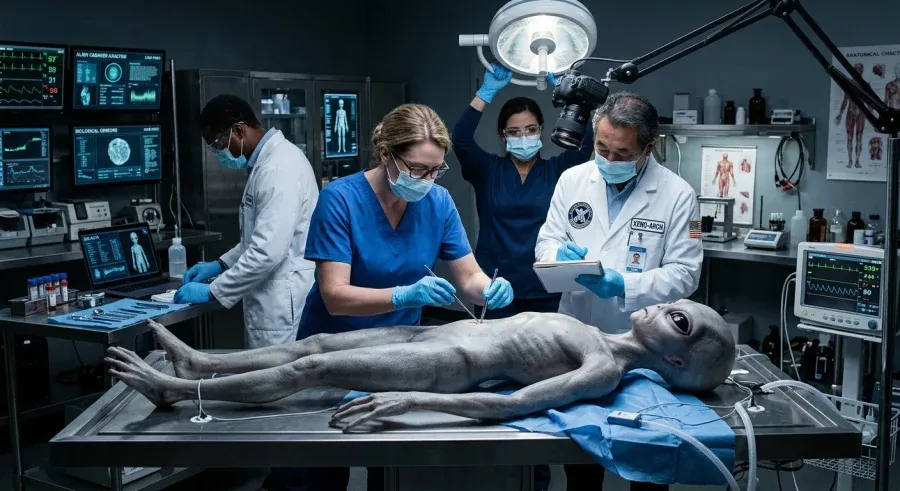
During the show, Puthoff did not detail the nature of the four species. According to the New York Post, it was his former AAWSAP colleague, physicist Eric Davis, who had previously mentioned four categories: the “Grays,” the “Nordics,” the “Insectoids” and the “Reptilians.” The Grays correspond to the archetype of small, hairless beings with large black eyes. The Nordics are said to be the closest to humans. Reptilians are described as scaly creatures walking on two legs, and Insectoids evoke praying mantises.

This catalog is nothing new: it matches almost point for point the typology that has circulated in UFO literature since the 1950s and 1960s. Author Kent Heckenlively, interviewed by Fox News Digital, pointed out that Grays are the most frequently described, while Insectoids are reported more rarely.

Dan Farah’s Testimony: Sources “Too Frightened to Speak”

Beside him, Dan Farah says several senior intelligence officials interviewed for his film stated on the record that dozens of craft of non-human origin have crashed over the decades. He also says he spoke privately with people linked to these operations, many of whom fear speaking publicly. He recounts that one source withdrew at the last minute, convinced that an interview would cost them their life.

None of these people is named, and no document, sample or image has been produced to support these accounts.

The Shadow of David Grusch and Congress

These statements follow in the wake of David Grusch’s testimony. A former US Air Force intelligence officer and ex-member of the UAP task force, he stated under oath before a House committee in July 2023 that the US government held “non-human biologics” from crash sites. Like Puthoff, Grusch said he got his information from witnesses rather than observing it himself. His hearing set off a global debate over the possible existence of secret retrieval and reverse-engineering programs within the military and intelligence apparatus.

The 2026 political context adds further resonance: the Trump administration is promoting a policy of transparency on UAP, and the Pentagon released a second batch of documents on the subject in late May. Puthoff, for his part, welcomed this momentum, judging some of the disclosures remarkable.

Reconstructed Dossier: What the Established Facts Say

Summary document reconstructed by the editorial staff from public sources. It contains only verifiable elements.

DOSSIER – ALLEGED RECOVERIES OF NON-HUMAN CRAFT

1947: Roswell incident (New Mexico). A 1994 US Air Force report attributes it to Project Mogul, a balloon program designed to detect Soviet nuclear tests. A second report, in 1997, explains the accounts of “bodies” as parachuted test dummies.

2008-2012: Pentagon AAWSAP program, funded by federal money and carried out by Bigelow Aerospace.

July 2023: David Grusch testifies before Congress; allegations of “non-human biologics,” with no physical evidence made public.

2024: The Pentagon’s AARO office publishes the first volume of its historical record report and concludes it has no verified evidence of recovered extraterrestrial technology.

May 2026: Hal Puthoff’s statements about “at least four” types of beings, relayed secondhand.

Status of the evidence: No physical item has been submitted for independent examination.

Critical Analysis: Thirdhand Testimony

Methodologically, Puthoff’s statement carries very little evidentiary weight, and he himself does not claim otherwise. It rests on a chain of transmission: unknown people allegedly took part in recoveries, they allegedly told researchers, who allegedly told Puthoff, who tells a microphone. Each link adds uncertainty, and none can be verified.

The Pentagon, for its part, has taken the opposite view. In 2024, the AARO office reviewed decades of files and interviews and found no verified evidence of recovered extraterrestrial technology. Its first director, Sean Kirkpatrick, defended that position, and independent analysts such as Mick West stress that many crash rumors rest on memory confusion, retold stories and misidentifications.

The striking resemblance between the evoked “bestiary” and popular culture is also worth noting: the Grays, popularized notably after the Betty and Barney Hill case in 1961, have taken hold in film and television, raising the question of possible contamination of the accounts by the collective imagination. Skeptics finally recall that the “disclosure” community has long maintained close ties among officials, producers and media players, which encourages the circulation of stories without independent checks.

NASA puts it soberly: the agency has not discovered life on another planet and has no scientific evidence of extraterrestrial life, but cannot say at this stage that aliens do not exist. It continues its search, notably for microbial forms.

Why These Stories Fascinate

Beyond the question of evidence, the affair reveals a social phenomenon. With a respected researcher on one side, a hit documentary on the other, a platform of millions of listeners and a favorable political climate, the “crash retrieval” hypothesis has become a central narrative of contemporary American culture. It is a narrative where documented facts (the existence of AAWSAP, the congressional hearings, the Navy videos) mingle with unverifiable assertions, at the risk of blurring the line between the two.

“I have not had direct access to that, but I believe the people I talked to.”
— Hal Puthoff, on the four types of beings allegedly recovered

That sentence sums up the situation on its own: a sincere conviction, probably, but not proof. Until a sample, an authenticated document or a direct witness is submitted to independent examination, the story of the four species will remain what it is today: a secondhand assertion, spectacular and unsubstantiated.

Légende - Photo
Gemini, CC0,
Sources
TagsAlien