2026-10-23

Bruno Amadio: The Painter Who Allegedly Made a Pact with the Devil

Bruno Amadio: The Painter Who Allegedly Made a Pact with the Devil

Behind the glistening eyes of "The Crying Boy," once hung in millions of living rooms, lies one of the most persistent urban legends of the twentieth century: an artist, an orphan nicknamed "Diablo," and a curse said to spare the paintings while the houses around them go up in flames. An investigation into a myth born in a British tabloid.

A Weeping Child in Millions of Homes

You have almost certainly seen him: a child with a fixed gaze, cheeks wet with tears, lips turned down, often dressed in a dark jacket against a black or ochre background. In a grandmother's hallway, in a hotel corridor, on the wall of a flea market stall. Reproduced in the hundreds of thousands from the 1950s onward, the image became a monument of European kitsch. In some countries it hung in practically every household: an Israeli columnist, recalling his youth, says it was hard to find a home without this tearful boy on the wall.

But since 1985, the portrait has also carried a far more sulfurous reputation: that of a cursed object, drawn to fire, signed by a painter who supposedly sold his soul.

Who Was Bruno Amadio, Really?

The "Crying Boys" are generally signed "Bragolin," sometimes "Giovanni Bragolin" or "Angelo Bragolin." Yet no painter ever existed under that name. According to the available biographies, the pseudonym hides Bruno Amadio, born in Venice in 1911 (on November 9 according to some sources, January 15 according to others) and died in Padua on September 22, 1981. He also used other pen names, including "Franchot Seville."

Trained at the academy, Amadio worked in postwar Venice as a painter and restorer, producing for tourists these portraits of tearful children. At least sixty variants are attributed to him, in boy and girl versions, which the image industry then reproduced worldwide without always paying him properly. Another detail contradicts the legend: in the 1970s he is found alive and well, fairly prosperous, and still at his easel in Padua.

The Legend: An Orphan, a Priest, and a Pact

Here the popular tale takes a frankly diabolical turn. In the most widespread version, Amadio fled Italy for Spain after the war. There he met a small vagrant boy, an orphan whose family had supposedly died in a fire. A priest warned the painter: wherever the child went, fire followed. The boy's nickname, "Don Bonillo" or, more dramatically, Diablo, completed his reputation as a little demon.

Amadio, out of pity or pride, ignored the warning, took the child in, and painted his series of portraits. Then his studio supposedly burst into flames. Convinced that the boy was responsible, the painter drove him away. In most versions the child then dies in a car accident or a fire, and his portraits, now steeped in his curse, begin spreading fire through homes. The painter himself is said to have perished in the flames.

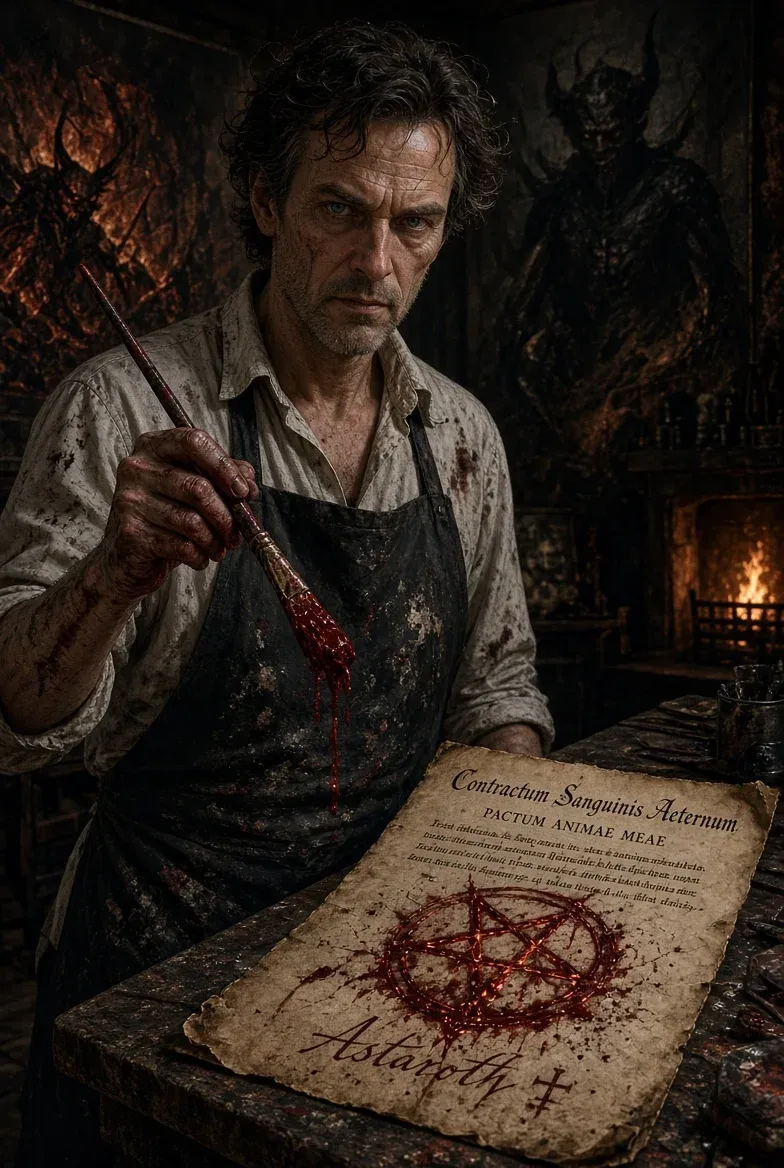
That is the "pact": an artist who agrees to share his roof, and his glory, with a child the rumor calls damned.

1985: "Blazing Curse of the Crying Boy"

Yet the curse was not born in Spain, but in the columns of the British press. In early September 1985, a local newspaper in Rotherham, South Yorkshire, reported a house fire. Two days later, the national tabloid The Sun seized on the story. On September 4, on page 13, it ran an article titled "Blazing Curse of the Crying Boy": a couple, Ron and May Hall, blamed a painting of a weeping child for the destruction of their home, with the picture supposedly the only object to have survived the flames. Ron's brother, a Rotherham firefighter, allegedly added that similar cases were circulating at the fire station. (Some sources date the publication to September 5.)

The research of folklorist David Clarke shows that the affair was blown out of proportion by the newspaper. Its editor at the time, Kelvin MacKenzie, sensed a good story. Weeks of letters from terrified readers, accounts of fires, and new "victims" followed. The legend grew to the point that families who owned a copy no longer wanted to keep it in the house.

The Sun's Bonfire

Faced with the flood of letters, the paper offered to take readers' reproductions off their hands and destroy them. On Halloween night 1985, around 2,500 prints were burned on a bonfire in Oxfordshire. A firefighter present mocked the ceremony: they had expected stifled screams, but heard only the crackle of paper. The tabloid then declared the spell broken.

"I always say it's the tears that put the fire out." – the wife of firefighter Alan Wilkinson, quoted by David Clarke in Fortean Times.

What Rational Criticism Says

The case is rich in mundane explanations, which skeptical investigators lay out without difficulty. First, the argument from numbers. The Sun itself estimated that around 50,000 copies were in circulation in the United Kingdom. When an object decorates that many homes, it mechanically turns up in a share of domestic fires. The bias is pure statistics: comedian Ray Peacock, in an episode of The ParaPod, ironically sums it up by saying that any popular record, present in as many living rooms, would be "cursed" too.

Then there is selection bias. No one reports "a fire where the Crying Boy burned": only the cases where it survives make the story. Investigators also noted that the paintings were not identical: "a motley assortment," in David Clarke's words, of cheap prints sold in British department stores in the 1960s and 1970s. The only thing they shared was mass marketing.

To explain why the frames survived, commentators generally point to how these reproductions were hung and the backing they were mounted on, but this hypothesis, common in the skeptical literature, remains a plausible explanation rather than definitive proof. It was in any case not taken up by The Sun, which, as Clarke notes, had no interest in looking for a rational cause.

Finally, the genealogy of the myth. David Clarke points out that the story of the orphan "Diablo" does not appear until 2000, from the pen of Liverpool author Tom Slemen. This storyline, which explains who the child is and why the painter would have come to a bad end, therefore postdates the 1985 panic by fifteen years. As for Amadio, far from perishing in the flames, he died of illness in Padua: broadcaster and comedian Steve Punt traced his story for BBC Radio 4 (Punt PI, 2010), then published his conclusions in The Sun. The legend of a Spanish exile and a burned orphanage could not be confirmed. Italian skeptic Massimo Polidoro, in the Skeptical Inquirer (November-December 2012), likewise files the affair under urban legends.

Why the Myth Survives

The story of the diabolical pact endures because it ticks every box of the gothic tale: an artist on the margins, a cursed child, an ignored warning from the clergy, an innocent-looking object that spreads misfortune. It also works as a remnant of the folklore of "haunted objects," in which a painting becomes the vessel of a presence. The internet has only revived the rumor: forums, videos, and dealers' listings swearing they hold "the original cursed one."

The mystery, in the end, is how a myth gets manufactured. A portrait of a sad child, sold by the dozen to tourists in Venice, was enough to feed four decades of fear, with a well-oiled media cycle as its only "devil." Bruno Amadio never signed a pact. He painted, he sold, and without knowing it he left behind one of the finest case studies in crowd psychology.

Légende - Photo
Grok, CC0,
Sources
TagsSatanism

2026-09-29

Johnny Hallyday and the Devil: Anatomy of a Sulphurous Legend

The montage has been circulating for years on social media and forums. It shows Johnny Hallyday, camera rolling, claiming to talk to the Devil "every day," insisting it is not a joke, then explaining that the registration plate of his car, JH 666, is no coincidence. Then comes the "confession": he supposedly signed a pact to reinvent himself and will go to Hell. It is often accompanied by a song title, "Je suis le fils de Lucifer" ("I Am the Son of Lucifer"), and by a conclusion delivered in the tone of a revelation: the stars have "almost all signed," and the public keeps applauding.

The device is effective: short sentences, a familiar face, a loaded number. What remains to be determined is which parts of this story are documented, which are rumour, and which are editing. We followed the trail.

What Can Actually Be Verified

The most solid fact is also the least spectacular. The pact does not appear in a filmed statement by the artist, but in reported testimony: in October 2018, on the programme "Radio Brunet" on RMC, journalist François Jouffa, presented as a close acquaintance of the singer, claimed that Hallyday had confided to him, "in all seriousness," that he had signed a pact with the devil. The clip was later recycled endlessly by religious or conspiracy-leaning websites.

"Signed a pact with the devil and that he would go to hell" — words attributed to Johnny Hallyday by journalist François Jouffa, RMC, 19 October 2018

Since the singer died on 5 December 2017 in Marnes-la-Coquette, these words can neither be confirmed nor denied by the man himself. That is the first point to keep in mind: this is reported speech, with no known original recording, from a private conversation whose tone nobody can establish (a serious confidence, a joke, or the provocation of a veteran rocker).

As for the phrase "I converse with the devil every day," it has circulated on forums since at least late 2018 as a video excerpt whose primary source we could not trace: no programme, no date, no recording context. The same goes for the "JH 666" plate: we found no document, authenticated photograph or verifiable testimony establishing it. Finally, our searches turned up no trace of a song titled "Je suis le fils de Lucifer" in the artist's discography. These three elements must therefore be considered unestablished.

The Context: A Posthumous Album and a Disturbing Song

What gave the rumour a second life was the release, in October 2018, of the posthumous album "Mon pays c'est l'amour," whose opening track is titled "J'en parlerai au diable" ("I'll Talk to the Devil About It"). The lyrics evoke a day of reckoning, of "honouring the pact" and sitting at the devil's table to tell one's truth. For proponents of the diabolical thesis, it is a confession; for others, it is a life review written by a gravely ill man playing with a classic poetic figure.

The devil was not a stranger to his work, moreover: a title such as "Un diable entouré d'anges" ("A Devil Surrounded by Angels") already appeared on the album "À partir de maintenant…" in 1980. The motif is old, and above all literary.

666: A Number That Does the Work for You

The number 666 is the "number of the Beast" from chapter 13 of the Book of Revelation. Some very ancient manuscripts actually give 616, a reminder that the interpretation of this figure is far from settled. Today, 666 has become a badge of recognition in hard rock and metal culture, brandished by artists who see it as nothing more than a stage prop.

A traditionalist Catholic activist site claims Johnny Hallyday had this number tattooed in his final years, a source to be handled with caution given its openly religious reading of events. Even if the fact were accepted, it would prove only one thing: a rock singer's use of a provocative symbol, in a tradition dating back to the 1970s.

Faust, Robert Johnson and Paganini: The Long History of the Pact

The "pact with the Devil" was not born with rock. The legend of Faust, set down in Germany during the Renaissance, is its archetype. In the eighteenth century, the violinist Giuseppe Tartini said he dreamed the Devil played a sonata for him, which he then tried to transcribe as his "Devil's Trill Sonata." In the nineteenth, Niccolò Paganini, whose virtuosity astonished audiences, was suspected of sorcery. In the twentieth, the bluesman Robert Johnson inherited the legend of a soul sold at a Mississippi crossroads.

The pattern is always the same: a talent judged "too great" or a reinvention judged "too sudden" calls for a supernatural explanation. The legend says less about the artist than about the public's difficulty in accepting work, chance and genius as sufficient causes.

Rock, or the Art of Cultivating a Dark Side

Rock has turned the sulphurous into a business model. Black Sabbath built its identity on occult imagery, and the "devil horns" gesture, popularised in metal by Ronnie James Dio, became the salute of an entire audience, with no religious meaning for most of those who make it. In this context, a singer who lets doubt linger about his infernal associations is practising a form of storytelling: the rumour feeds the myth, and the myth feeds sales.

With Hallyday, a figure of French rock raised to the rank of national institution, this play with darkness was part of a persona built since the 1960s: the rebel, the biker, the survivor.

Critical Analysis: Why the Pact Thesis Appeals

Three mechanisms explain the story's effectiveness. The first is apophenia, the tendency to link unrelated elements (a number, a song, a confidence) into a system. The second is confirmation bias: once the thesis is accepted, every song title or stage gesture becomes "proof." The third is posthumous rereading: a song recorded by a man aware that his end is near is read in light of his death, which loads every word with additional meaning.

As for the closing claim, "almost all of them signed," it is unfalsifiable: no evidence can contradict it, since the absence of a pact would be read as a well-kept secret. This is the classic hallmark of conspiratorial reasoning, which relies not on specific facts but on conviction. It also ignores survivorship bias: we cite the artists who succeeded, never those who would have "signed" and gained nothing.

Finally, an ethical question: the witness's words are reported, the artist is dead, and the viral montage provides no date, no source and no context. Attributing unverifiable statements to a deceased man in order to make him an example of an occult system is closer to rhetoric than to investigation.

Key Takeaways

A secondhand testimony broadcast on RMC in 2018 attributes to Johnny Hallyday confidences about a pact with the devil. A posthumous song with an evocative title revived the debate. The rest of the file (a filmed daily dialogue, the "JH 666" plate, the song "Je suis le fils de Lucifer") is, at this stage, supported by no primary source we have been able to find. The story is fascinating, but it belongs to contemporary folklore rather than to established fact. If a reader has the original video excerpt, its context or a photograph of the plate,

Légende - Photo
Gemini, CC0,
Sources
TagsSatanism

2024-07-20

Pazuzu Algarad: The Sinister Tale of North Carolina's "Demon"

Pazuzu Algarad: The Sinister Tale of North Carolina's "Demon"

Pazuzu Algarad, born John Alexander Lawson on August 12, 1978, became infamously known for the horrific crimes he committed in a small North Carolina town. His story is one of a frightening descent into the world of occultism and depravity, marked by gruesome murders and a deeply disturbed personality.

The Transformation into Pazuzu

John Lawson grew up in an apparently ordinary family, but his teenage years were characterized by increasingly erratic and violent behavior. Fascinated by the occult and demonic beliefs, he adopted the name Pazuzu Illah Algarad, referencing a Mesopotamian demon. He covered himself in sinister tattoos and altered his appearance to align with his new demonic identity.

A House of Horrors

The house where Algarad lived with his mother in Clemmons, North Carolina, became the site of nightmarish scenes. Neighbors and visitors described the house as a place of horror, filled with satanic graffiti, filth, and a pervasive stench. Algarad had turned this house into a shrine for his macabre rituals and occult practices.

The Gruesome Crimes

In October 2014, police discovered the bodies of two men buried in the backyard of Algarad's home. Tommy Dean Welch and Joshua Frederick Wetzler had been missing for several years, and investigations revealed they had been brutally murdered by Algarad and his accomplices. These discoveries shocked the local community and brought to light the extent of Algarad's atrocities.

Trial and Conviction

Pazuzu Algarad was arrested and charged with the murders of Welch and Wetzler. In 2015, he was convicted for his role in these murders, as well as for assisting his accomplices. However, Algarad never faced a final sentencing. On October 28, 2015, he was found dead in his cell, an apparent suicide.

Légende - Photo
selline, Pixabay, https://pixabay.com/fr/illustrations/ai-g%C3%A9n%C3%A9r%C3%A9-monstre-diable-diabolique-8651602/
Sources

2024-03-17

Tartini's sonata: a work inspired by Satan

The Devil's Trill Sonata, also known as "Sonata in G minor for Violin, Op. 1, No. 4, B.G5", is a remarkable composition by the renowned Italian composer and violinist Giuseppe Tartini (1692-1770). This iconic piece, considered one of the most demanding in the violin repertoire, has gained worldwide renown not only for its technical complexity but also for the fascinating story that surrounds it.

The Devil's Trill Sonata was composed by Tartini in the early 18th century, likely between 1713 and 1714. This solo violin sonata consists of four movements: Larghetto affettuoso, Allegro moderato, Andante, and Presto, each demanding exceptional virtuosity from the violinist.

What particularly distinguishes this sonata are the rapid and intricate trill passages that unfold throughout the work, hence its evocative nickname. These trills, requiring great dexterity and extreme precision, pose a formidable challenge for performers, contributing to the reputation of the piece as a masterpiece of the violin repertoire.

The Legend of the Pact with the Devil

The legend surrounding the Devil's Trill Sonata adds a mystical dimension to this already remarkable work. According to tradition, Tartini had a dream in which he made a pact with the devil, asking him to teach him the violin. In this dream, the devil played music of transcendent beauty, from which Tartini awoke deeply inspired yet also frustrated by his inability to reproduce those divine sounds.

To express his frustration and fascination, Tartini purportedly composed the Devil's Trill Sonata, attempting to capture even a fraction of the music he had heard in his dream. The sonata is thus interpreted as a representation of Tartini's trials and torments in his quest for musical perfection, reflecting both the fascination and anguish of his dream experience.

In a legendary anecdote, the musician told the astronomer Jérôme Lalande about the genesis of this incredible sonata:

"One night, in the year 1713 I dreamed I had made a pact with the devil for my soul. Everything went as I wished: my new servant anticipated my every desire. Among other things, I gave him my violin to see if he could play. How great was my astonishment on hearing a sonata so wonderful and so beautiful, played with such great art and intelligence, as I had never even conceived in my boldest flights of fantasy. I felt enraptured, transported, enchanted: my breath failed me, and I awoke. I immediately grasped my violin in order to retain, in part at least, the impression of my dream. In vain! The music which I at this time composed is indeed the best that I ever wrote, and I still call it the "Devil's Trill", but the difference between it and that which so moved me is so great that I would have destroyed my instrument and have said farewell to music forever if it had been possible for me to live without the enjoyment it affords me."

Cultural Impact and Legacy

The Devil's Trill Sonata has become one of the most iconic pieces in the violin repertoire, performed and studied by generations of violinists worldwide. Its influence extends far beyond the world of classical music, inspiring adaptations, tributes, and references in various artistic media.

This work embodies not only the technical virtuosity and emotional expression characteristic of baroque music but also the power of myth and legend in artistic creation. The fascination with the tale of the pact with the devil has helped keep Tartini's memory and music alive, adding a layer of mystery and mysticism to his already impressive musical legacy.

Légende - Photo
Андрей Романенко, Public domain, https://en.wikipedia.org/wiki/Violin_Sonata_in_G_minor_(Tartini)#/media/File:Le_Songe_de_Tartini_par_Louis-L%C3%A9opold_Boilly_1824_(color).jpg
Sources

2024-01-04

Book - Satanism

Book - Satanism


Abstract

Bob Larson's book, "Satanism: The Seduction of America's Youth," delves into the various influences leading American youth towards a perilous pact with Satan. Larson identifies these forces as ranging from macabre games and horror films to black metal music and the pervasive presence of drugs. Moreover, he highlights the occult enticements embedded in contemporary culture that contribute to this seduction.

Larson provides specific insights for parents and counselors, offering practical strategies to counteract these influential forces in the lives of teenagers. By addressing the multifaceted aspects of youth culture, including entertainment choices and societal trends, Larson aims to empower those responsible for guiding and protecting young individuals. The book serves as a call to action, urging proactive measures to safeguard the vulnerable youth from the allure of satanic influences.


Satanism

Author : Bob Larson
ISBN 10 : 0840730349
ISBN 13 : 9780840730343
Numbers of pages : 232
Publisher : Thomas Nelson
Publication date : September 26, 1989

More books on Paranormal Book

2020-10-12

Man fatally beats his daughter possessed by Satan

Man fatally beats his daughter possessed by Satan

In 1913, a very religious father killed his own daughter. He was sure she was possessed by a demon.

Julien, a farmer living in France, and his wife were arrested for beating their eldest daughter to death. Two other children of the couple have been charged with aiding and abetting murder.

The young girl reportedly told her parents that she was possessed by a demon. His family then decided to exorcise her. For this, they beat her until the demon left his body.

Légende - Photo

Painting of Saint Francis Borgia performing an exorcism, as depicted by Goya

Sources