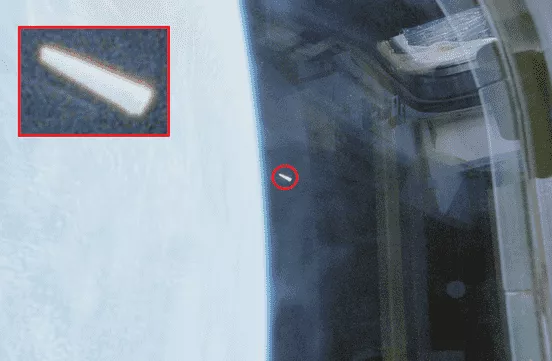
In November 1996, during the STS-80 mission of Space Shuttle Columbia, astronauts photographed an unidentified object in low-Earth orbit. The object appears near the center of the image, to the right of Earth's limb, standing out clearly against the dark background of space.
Its unusual shape and the lack of a detailed official explanation have raised many questions over the years. Some believe it could simply be a piece of space debris or the result of a photographic artifact, while others suggest it may represent an unidentified anomalous phenomenon (UAP). In the absence of conclusive evidence regarding its origin, the image remains one of the most intriguing photographs captured by NASA during the STS-80 mission.
Légende - Photo U.S.G., Public Domain, https://www.war.gov/ufo/#NASA-UAP-D030-STS-80-Unidentified-Object-Image-1-1996
Some objects, it is said, bring misfortune to whoever handles them carelessly. The Ouija board, that old companion of séances popularized in the late 19th century, has just offered fresh proof of this — not in a haunted parlor or a lonely cemetery, but in the decidedly prosaic offices of the Moses Lake Police Department in Washington State. Last Friday afternoon, a resident in the 1100 block of East Nelson Road reported that their vehicle had been broken into while they were away. The stereo had been torn from the dashboard, house keys and several prescription medications were missing — and along with them, a Ouija board.
It was this last, seemingly trivial detail that would ultimately seal the suspect's fate.
Chance, an officer's memory, and a traveling board
Earlier that same day, Officer Isaac Taylor of the Moses Lake Police Department had had a routine encounter with a woman carrying a Ouija board in a bag — an object unusual enough to stick in a patrolling officer's memory. When the burglary report came in a few hours later, mentioning a Ouija board among the stolen items, Officer Taylor recalled the earlier encounter. He located the woman, later identified as 36-year-old Tasha Marie Wehrli, near Pioneer Way and Riviera Avenue.
A search confirmed the suspicion: not only was the Ouija board still in her possession, but so were the other items reported stolen from the vehicle. According to the police department's statement, Wehrli then allegedly attempted to flee before being subdued and arrested without further incident.
A heavy charge sheet
Tasha Marie Wehrli was booked into Grant County Jail on multiple counts: second-degree vehicle prowling, third-degree theft, possession of a legend drug (a prescription medication held without a valid prescription), third-degree malicious mischief, and resisting arrest. Under Washington State law, second-degree vehicle prowling is classified as a gross misdemeanor, carrying a maximum penalty of up to a year in jail; the statute does not even require that anything actually be taken from the vehicle for the offense to be established — mere intent to commit a crime inside is sufficient.
The Ouija board, an object steeped in history — and superstition
Far from being a mere flea-market curiosity, the Ouija board belongs to a long American tradition of supposed communication with the beyond. First marketed in 1890 under the name "Ouija," then popularized in the following decades by manufacturer William Fuld, it became the very symbol of the domestic séance, at a time when the Spiritualist movement — born from the Fox sisters' phenomenon at Hydesville in 1848 — was enjoying considerable popularity across the United States. Used both as a family parlor game and as a serious divination tool, the board has carried a troubled reputation through the 20th and 21st centuries: some see it as a simple parlor game driven by the ideomotor effect — the unconscious muscular movement that, according to many psychologists, accounts for the planchette's motion without any supernatural intervention — while others continue to view it as a doorway, sometimes a dangerous one, onto the unseen.
Whether one leans toward the rational explanation or the paranormal thesis, the Moses Lake episode feeds a particular strand of folklore: that of stolen objects which, one way or another, end up turning against their thief.
Superstitions of the criminal underworld
There is a persistent idea in American popular culture that criminals form a particularly superstitious lot — an observation owed, among other things, to the mythology of Gotham City's masked vigilante, but one that also finds a more serious echo among criminologists studying the rituals and beliefs peculiar to criminal circles. In publishing the details of the arrest on social media, the Moses Lake Police Department did not fail to note the irony of the situation: an object traditionally meant to reveal hidden truths ended up, in this case, playing a very concrete role in revealing a suspect's identity.
"Many say that criminals are a superstitious lot. In this case, it would seem that the old adage held true in the most literal way possible."
What the official statement says
The passage below faithfully reproduces, in translation, the account released by the Moses Lake Police Department regarding the circumstances of the arrest:
"On Friday afternoon, officers responded to a report of a vehicle prowl in the 1100 block of East Nelson Road. The stereo had been ripped from the dashboard; house keys and several prescription medications had been taken, along with a Ouija board. Earlier that day, Officer Isaac Taylor had contacted a woman, later identified as Tasha Marie Wehrli, who was carrying a Ouija board in a bag. Remembering the encounter, he relocated Wehrli near Pioneer Way and Riviera Avenue. A search recovered the board along with the other items reported stolen. Wehrli was booked into Grant County Jail on charges of second-degree vehicle prowling, third-degree theft, possession of a legend drug, third-degree malicious mischief, and resisting arrest."
On August 5, 1953, shortly after nightfall, Ellsworth Air Force Base, at the time one of the Strategic Air Command's most sensitive installations in South Dakota, became the stage for what Captain Edward J. Ruppelt, the first director of Project Blue Book, would later call "the best UFO report in the Air Force files." Within a few hours, military radar operators, fighter pilots, and some forty-five civilians would all converge on the same unsettling conclusion: something was flying over the skies of South Dakota, and it obeyed no known law of aeronautics.
The alert from Blackhawk
It all begins in Blackhawk, a small town about ten miles west of the base. Mrs. Phyllis Kellian (sometimes spelled "Killian" in secondary sources), a volunteer observer with the Ground Observer Corps — the civilian network tasked with watching for enemy bombers at the height of the Cold War — spots a bright red light low on the northeastern horizon around eight o'clock in the evening. Motionless at first, the light suddenly shifts thirty degrees, shoots straight up, then returns to its original position before streaking off toward Rapid City at high speed. Trained in the proper procedure, Mrs. Kellian immediately reports the sighting, and is put through directly to the on-duty radar controller at Ellsworth.
Radar confirmation and the first scramble
The duty officer immediately picks up a solid, well-defined return on his scope, stationary at 16,000 feet, exactly where Mrs. Kellian places the light. Three airmen are sent outside and visually confirm a light moving north to south at high speed. At 8:24 PM, Lieutenant John W. Stockham, on combat air patrol aboard an F-84D Thunderjet, is vectored toward the area. He acquires a silvery light "brighter than any star" and begins his approach. But as he closes to within about three miles, the object suddenly accelerates to the northwest, stubbornly maintaining the gap.
A 120-mile pursuit
The chase continues for nearly 120 miles, with the object and the F-84 crossing into North Dakota under the unbroken watch of ground radar, which tracks both blips without interruption. Low on fuel, the pilot is forced to turn back. He would later tell Ruppelt he was "damn glad" he was running low on gas, given how unsettling it was to be alone, at night, over such desolate country, chasing something he simply could not outrun.
The radar controller, for his part, would remember the extraordinary composure the night demanded of him. According to the account he later gave Ruppelt, the object seemed to carry some kind of automatic warning system tied to its propulsion: every time the fighter closed to within three miles, the target would "automatically pick up speed and pull away" — a distance-maintaining behavior that would become one of the most closely studied aspects of the case.
The second interceptor and the locked-on gunsight
Back at the base, Stockham's F-84 crosses paths with a second aircraft already on alert: the squadron's pilots, having followed the radio traffic, refused to believe it. One of them, a World War II and Korea veteran, insists on taking off himself. Lieutenant David K. Needham takes the controls. Climbing to 15,000 feet, he spots the object below and to his right: a light shifting from white to green, moving erratically. Needham climbs to 26,000 feet in pursuit. According to his official report, filed in writing in the days that followed, he switches on his radar-ranging gunsight — not to open fire, but to confirm the object's solidity. The lock-on light comes on and stays lit throughout the pursuit, a detail the Air Force would later attribute to a malfunction, though no maintenance record for the equipment turns up in the weeks that follow.
Blue Book's verdict, and the doubt that remains
Astronomer J. Allen Hynek, then scientific advisor to Project Blue Book, was initially convinced of the phenomenon's material reality, writing in November 1953 to Captain Charles A. Hardin that "solid objects are certainly indicated by the evidence." The case would later be reexamined by the Condon Report in 1968, whose investigators proposed an explanation involving anomalous radar wave propagation caused by a temperature inversion — the object's echo, under this theory, being nothing more than an artifact of the F-84's own radar signature. But this hypothesis struggles to account for why the echo remained distinct and unwavering from the jet's own return across the full 120 miles of pursuit, all the way until it passed out of radar range over North Dakota. For Ruppelt, in the end, the Ellsworth case would remain, for lack of a better explanation, officially unidentified.
"The controller saw it begin to move, the spotter saw it begin to move, and the pilot saw it begin to move — all at the same time." — Captain Edward J. Ruppelt, former director of Project Blue Book
Archival document: report by Lieutenant David K. Needham (translated excerpt)
Excerpt from the official AF Form 112-Part I report, dated August 5, 1953, from the declassified files of the U.S. Air Force:
"At 2115 hours, Mountain Standard Time, on 5 August 1953, I took off in an F-84 to conduct a Combat Air Patrol. Approximately three minutes later, I contacted Grady Control by radio. Grady informed me that the Ground Observer Corps had spotted a flying object (a light) in the air northeast of Black Hawk, South Dakota. Grady requested that I investigate the object, but was unable to give information concerning the object's speed, heading, or altitude. After making three requests to Grady for a vector to the vicinity of Black Hawk, I finally saw what was apparently the object. At the time of detection, I was on a course of 330 from Ellsworth AFB at 15,000 feet. The object was approximately thirty degrees to the right of my course, and appeared to be paralleling my course at a lower altitude. The object was a light of varying intensity and alternated from white... [document partially illegible]. As for the exact size of this craft, it would be a little hard to say, but considering the altitude it seemed to be at, and judging from its apparent relation to the contours of the surrounding terrain, I would estimate it was between twenty and thirty feet in diameter. I say this because of the few seconds during which I was able to observe this craft; I also saw its wake, or path."
Légende - Photo Dual Freq, Public domain, https://commons.wikimedia.org/w/index.php?curid=1866883
It is a little past one in the morning on March 31, 1993, when the telephones at the British Ministry of Defence begin ringing without pause. Within a few hours, more than a hundred witnesses across the west of England — including numerous police officers and military personnel on active duty — report seeing luminous craft moving through the night sky at astonishing speed. The affair, which would go down in the annals as the "Cosford Incident," would become one of the most thoroughly documented UFO files ever handled by the British authorities.
It was Nick Pope, then head of the "UFO desk" (the so-called Sec(AS)2a) at the Ministry of Defence, who inherited the investigation. By his own account,"the phones were ringing off the hook"when he arrived at his desk on the morning of the 31st, the previous night's reports already piled up before him.
Over the Somerset hills, "like two Concordes joined together"
The first notable testimony comes from the Quantock Hills in Somerset, where a police officer accompanying a group of scouts describes a triangular craft gliding across the sky at tremendous speed. His description, since become well known, likened the shape to two supersonic Concorde airliners flying side by side, as though welded together. Further reports soon poured in from Cornwall, Devon, and the West Midlands, sketching out a wave of sightings that appeared to sweep across the whole of south-west England within a matter of hours.
RAF Cosford: two white lights "at great velocity"
It was above RAF Cosford, in Shropshire, however, that the sighting occurred which would lend its name to the entire affair. An RAF Police patrol reported seeing two creamy-white lights, accompanied by a faint reddish glow at the rear, pass overhead at an estimated altitude of roughly 1,000 feet. The official police report, classified "Police In Confidence," stressed the object's extreme speed and its complete silence — two characteristics that, in the witnesses' view, ruled out any known conventional aircraft.
RAF Shawbury: a beam of light that "seemed to be looking for something"
A little over an hour later, it was the turn of the neighbouring base at RAF Shawbury to become the scene of an even more dramatic observation. The duty meteorological officer, whom Nick Pope has never publicly named out of respect for his anonymity, described an object roughly the size of a C-130 transport aircraft or a Boeing 747, moving slowly — at no more than 30 to 40 miles per hour — towards the base's perimeter. The craft then projected a laser-like beam of light that swept back and forth across the ground, as though it "were looking for something." A deep, continuous humming sound could be heard, felt almost as much as it was audible. Then, abruptly, the light switched off and the object shot away at breathtaking speed, leaving the witness — a man well accustomed to observing military aircraft — thoroughly unsettled.
Radar stays silent, the Ministry of Defence takes note
Troublingly, neither RAF Shawbury nor RAF Cosford managed to pick up any trace of the object on radar at the time of the sightings. In his official report to his superiors, Nick Pope went so far as to write that an unidentified object of unknown origin appeared to have been operating within the UK Air Defence Region without being detected, which, in his own words, seemed to be of considerable defence significance warranting further investigation. The Ministry even went so far as to formally ask the United States military whether the craft observed belonged to their own forces — an unusual step, revealing just how seriously the affair was treated behind closed doors.
The space-debris theory: an explanation that divides opinion
Not every explanation, however, points toward the extraordinary. On the evening of March 30, 1993, the Commonwealth of Independent States — successor to the USSR — had launched a radio satellite into orbit aboard a rocket whose booster stage later broke apart on re-entering the atmosphere. Computer-simulated trajectories for the falling debris coincide, according to some researchers, with several reports of "bright lights" that same night. Jenny Randles, a prominent figure within the British UFO Research Association, went further still, suggesting that the Shawbury meteorological officer's account might be explained not by an extraordinary craft but by the passage of a police helicopter — a possibility the witness himself would later come to consider more seriously.
A file that, thirty years on, refuses to close
Despite these more prosaic leads, the Cosford Incident continues to divide researchers and skeptics alike. Nick Pope himself has maintained, for decades, that no explanation fully accounts for all of the testimonies gathered that night — particularly the beam of light and the humming sound described at Shawbury. His critics, meanwhile, point to inconsistencies in the timeline he has presented over the years, notably the gap of more than an hour separating the Cosford and Shawbury sightings, difficult to reconcile with the notion of a single craft travelling between the two bases. The British Ministry of Defence has since released the full case files relating to that night of March 30–31, 1993, departing from its long-standing position that UFOs held "no defence significance."
"It seems that an unidentified object of unknown origin was operating in the UK Air Defence Region without being detected on radar; this would appear to be of considerable defence significance, and I recommend that we investigate further." — Nick Pope's report to the Ministry of Defence, April 1993
Excerpt from the RAF Cosford police report
"The patrol observed two creamy-white lights, accompanied by a faint red glow at the rear, crossing the base's airspace at great velocity, at an estimated altitude of approximately 1,000 feet. No engine noise was heard. Further inquiries with other military bases, civil airports, and local police forces revealed a number of consistent civilian sightings reported in the same area during the same period." — RAF Police report, classified Police In Confidence, March 1993
Between 1982 and 1986, several thousand residents of Westchester County, New York, reported the recurring appearance of a massive, silent craft — shaped like a V or a boomerang — gliding at low altitude above the Taconic Parkway. Neither the investigators of the time nor the authorities ever fully explained the phenomenon.
A New Year's Eve Like No Other
According to the archives compiled by the earliest investigators, it began on the night of December 31, 1982, just minutes before midnight. A retired police officer, sitting in his backyard in the town of Kent, spotted a cluster of red, green, and white lights to the south. He first assumed it was a plane in distress. But the object passed over his house at an estimated height of about 150 meters, moving far too slowly and too quietly for a conventional aircraft — accompanied only by a low, distant humming sound. As he watched, he made out a dark, triangular fuselage connecting the lights, arranged in a V formation.
That lone account went largely unnoticed for months. It would take until the following winter for the case to take on an entirely different scale.
The Night of March 24, 1983: Yorktown's Switchboard Overwhelmed
A week after sheriff's deputy Dennis Sant spotted a dark, metallic object near Brewster that he would describe as "a city of lights," reports began pouring in once again. On March 24, 1983, a former police officer once more saw the V-shaped formation, this time accompanied by a more pronounced hum. That same night, IBM computer engineer Ed Burns was driving along the Taconic Parkway near Millwood when his car radio began crackling with static; he pulled onto the shoulder, joining dozens of other motorists, to watch what he would later describe as a massive, perfectly silent "triangular ship."
In Yorktown, calls flooded in so heavily that the local police switchboard nearly buckled under the load, to the point that officials feared they would be unable to handle genuine emergencies. Two officers present at the scene at the same time gave contradictory descriptions: one described a single mass carrying several lights, the other described a tight formation of small planes — a discrepancy that would fuel debate over the object's true nature for years to come.
A Scientific Investigation Takes Shape
On March 26, 1983, the Westchester-Rockland Daily Item ran a now-famous front-page story under the plain headline: "Hundreds Claim to Have Seen UFO." The article caught the attention of a group of independent researchers connected to J. Allen Hynek, a former scientific consultant to the U.S. Air Force on Projects Sign, Grudge, and Blue Book, and founder of the Center for UFO Studies. Alongside the astronomer, teacher and investigator Philip J. Imbrogno took charge of the fieldwork.
The team set up a dedicated hotline and logged more than three hundred calls in a single evening, on the night of March 24 alone. One witness, later quoted in their book, summed up the general impression in a line that would become well known among researchers working the case: if there were such a thing as a flying city, that was exactly what the object looked like that night. The findings of this investigation were eventually published by Hynek, Imbrogno, and journalist Bob Pratt in Night Siege: The Hudson Valley UFO Sightings, which remains the definitive documentary account of the case.
One Object, or Dozens of Prankster Pilots?
Given the sheer scale of the reports, the most commonly offered explanation was a hoax: a group of amateur pilots flying tight formations of ultralight aircraft, running flashing lights, to simulate a single craft. The theory found grim partial support on Halloween night 1984, when a small plane landed at Stormville Airport — one of the object's recurring flight paths — and its pilot was detained by a state trooper who suspected him of staging the sightings. The man denied any involvement and was never charged, but the report the officer wrote that night would become, in the eyes of skeptics, the key piece of evidence for the mundane explanation.
Imbrogno himself, however, rejected that single explanation for every sighting. He pointed out that the object had been seen well before these nighttime formation flights began, and that witnesses who observed multiple separate appearances reported clear differences between them — some matching the description of a single, rigid craft, others, later on, matching a swarm of small aircraft. Air traffic controller Anthony Capaldi, who himself observed the object over Stormville in the summer of 1983, further noted that aircraft flying in such a tight formation would necessarily have produced audible engine noise — yet nearly all witnesses insisted instead on the craft's near-total silence, broken at most by a faint hum.
The Flyover of the Indian Point Nuclear Site
The episode that gave the case its most unsettling turn came on June 14 and July 24, 1984, when several witnesses — including security guards at the Indian Point nuclear power plant on the eastern bank of the Hudson — reported a large, structured object moving slowly or hovering in the immediate vicinity of the reactors. One guard on duty estimated the craft at roughly 100 feet long, flying at under 900 feet, and compared it to several helicopters flying in extremely tight formation. For those inclined toward the extraordinary explanation, the object's proximity to such a sensitive facility as a nuclear plant made the prankster-pilot theory considerably less convincing; few ultralight enthusiasts, it was argued, would risk flying so close to a restricted installation.
A Phenomenon That Spread Far Beyond Westchester
According to estimates from the Hynek-Imbrogno team, the object — or objects — were seen by more than five thousand witnesses between 1982 and 1986, across an area extending well beyond Westchester County alone: reports also came from Putnam and Dutchess Counties, and as far as neighboring Connecticut, including New Haven and Brookfield. The reports point to a preferred flight path along the corridor formed by the Taconic Parkway, a marked tendency to hover over bodies of water, and exclusively nighttime appearances — no credible daytime sighting was ever recorded.
The case saw a major resurgence of media attention in 1992, when the American television program Unsolved Mysteries devoted a segment to it. The show managed to gather a group of pilots willing to claim responsibility for the formation flights — but they balked at publicly recreating the V-shaped maneuver they claimed to have flown, citing the FAA regulations such a demonstration would have violated. To this day, the case remains officially unsolved.
Timeline
December 31, 1982 — First recorded sighting, in Kent, New York. March 17, 1983 — Sighting by sheriff's deputy Dennis Sant near Brewster; traffic halted on Interstate 84. March 24, 1983 — Major wave of sightings; Yorktown's police switchboard overwhelmed; more than three hundred calls received by the investigation hotline in a single night. March 26, 1983 — Publication of the Westchester-Rockland Daily Item story; Hynek and Imbrogno's investigation begins. Summer 1983 — Sighting by air traffic controller Anthony Capaldi over Stormville. June 14 and July 24, 1984 — Reported flyovers near the Indian Point nuclear power plant. October 31, 1984 — A pilot is detained at Stormville Airport. 1992 — Unsolved Mysteries airs its segment on the case.
Archival Document — Witness Testimony Collected by Investigators
"If there is such a thing as a flying city, this was a flying city. There was no engine noise at all, just that low, almost continuous humming sound. The lights were arranged in a clear V shape, and the whole thing moved with a slowness that made no sense for an aircraft of that apparent size."
— Testimony quoted in Night Siege: The Hudson Valley UFO Sightings (Hynek, Imbrogno & Pratt), regarding the events of March 24, 1983.