
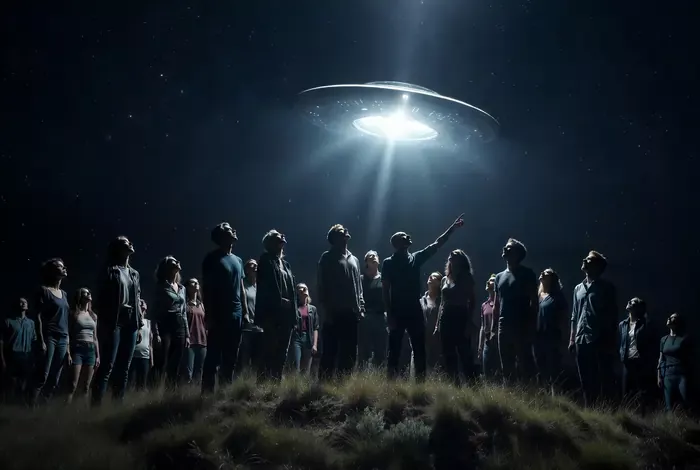
It is a little past one in the morning on March 31, 1993, when the telephones at the British Ministry of Defence begin ringing without pause. Within a few hours, more than a hundred witnesses across the west of England — including numerous police officers and military personnel on active duty — report seeing luminous craft moving through the night sky at astonishing speed. The affair, which would go down in the annals as the "Cosford Incident," would become one of the most thoroughly documented UFO files ever handled by the British authorities.
It was Nick Pope, then head of the "UFO desk" (the so-called Sec(AS)2a) at the Ministry of Defence, who inherited the investigation. By his own account,"the phones were ringing off the hook"when he arrived at his desk on the morning of the 31st, the previous night's reports already piled up before him.
Over the Somerset hills, "like two Concordes joined together"
The first notable testimony comes from the Quantock Hills in Somerset, where a police officer accompanying a group of scouts describes a triangular craft gliding across the sky at tremendous speed. His description, since become well known, likened the shape to two supersonic Concorde airliners flying side by side, as though welded together. Further reports soon poured in from Cornwall, Devon, and the West Midlands, sketching out a wave of sightings that appeared to sweep across the whole of south-west England within a matter of hours.
RAF Cosford: two white lights "at great velocity"
It was above RAF Cosford, in Shropshire, however, that the sighting occurred which would lend its name to the entire affair. An RAF Police patrol reported seeing two creamy-white lights, accompanied by a faint reddish glow at the rear, pass overhead at an estimated altitude of roughly 1,000 feet. The official police report, classified "Police In Confidence," stressed the object's extreme speed and its complete silence — two characteristics that, in the witnesses' view, ruled out any known conventional aircraft.
RAF Shawbury: a beam of light that "seemed to be looking for something"
A little over an hour later, it was the turn of the neighbouring base at RAF Shawbury to become the scene of an even more dramatic observation. The duty meteorological officer, whom Nick Pope has never publicly named out of respect for his anonymity, described an object roughly the size of a C-130 transport aircraft or a Boeing 747, moving slowly — at no more than 30 to 40 miles per hour — towards the base's perimeter. The craft then projected a laser-like beam of light that swept back and forth across the ground, as though it "were looking for something." A deep, continuous humming sound could be heard, felt almost as much as it was audible. Then, abruptly, the light switched off and the object shot away at breathtaking speed, leaving the witness — a man well accustomed to observing military aircraft — thoroughly unsettled.
Radar stays silent, the Ministry of Defence takes note
Troublingly, neither RAF Shawbury nor RAF Cosford managed to pick up any trace of the object on radar at the time of the sightings. In his official report to his superiors, Nick Pope went so far as to write that an unidentified object of unknown origin appeared to have been operating within the UK Air Defence Region without being detected, which, in his own words, seemed to be of considerable defence significance warranting further investigation. The Ministry even went so far as to formally ask the United States military whether the craft observed belonged to their own forces — an unusual step, revealing just how seriously the affair was treated behind closed doors.
The space-debris theory: an explanation that divides opinion
Not every explanation, however, points toward the extraordinary. On the evening of March 30, 1993, the Commonwealth of Independent States — successor to the USSR — had launched a radio satellite into orbit aboard a rocket whose booster stage later broke apart on re-entering the atmosphere. Computer-simulated trajectories for the falling debris coincide, according to some researchers, with several reports of "bright lights" that same night. Jenny Randles, a prominent figure within the British UFO Research Association, went further still, suggesting that the Shawbury meteorological officer's account might be explained not by an extraordinary craft but by the passage of a police helicopter — a possibility the witness himself would later come to consider more seriously.
A file that, thirty years on, refuses to close
Despite these more prosaic leads, the Cosford Incident continues to divide researchers and skeptics alike. Nick Pope himself has maintained, for decades, that no explanation fully accounts for all of the testimonies gathered that night — particularly the beam of light and the humming sound described at Shawbury. His critics, meanwhile, point to inconsistencies in the timeline he has presented over the years, notably the gap of more than an hour separating the Cosford and Shawbury sightings, difficult to reconcile with the notion of a single craft travelling between the two bases. The British Ministry of Defence has since released the full case files relating to that night of March 30–31, 1993, departing from its long-standing position that UFOs held "no defence significance."
"It seems that an unidentified object of unknown origin was operating in the UK Air Defence Region without being detected on radar; this would appear to be of considerable defence significance, and I recommend that we investigate further."
— Nick Pope's report to the Ministry of Defence, April 1993
Excerpt from the RAF Cosford police report
"The patrol observed two creamy-white lights, accompanied by a faint red glow at the rear, crossing the base's airspace at great velocity, at an estimated altitude of approximately 1,000 feet. No engine noise was heard. Further inquiries with other military bases, civil airports, and local police forces revealed a number of consistent civilian sightings reported in the same area during the same period."
— RAF Police report, classified Police In Confidence, March 1993
Grok, CC0,

0 comments: