
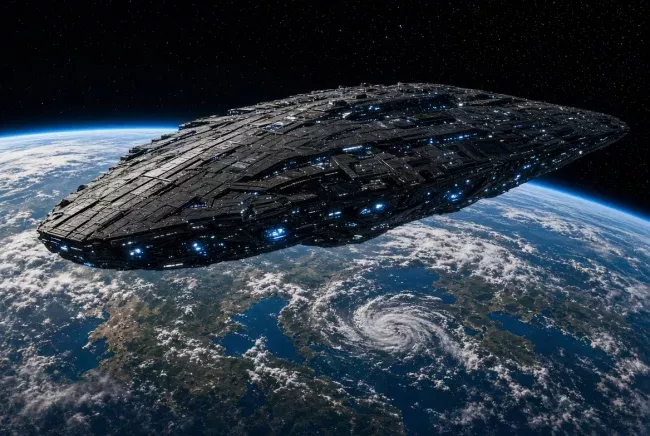
Two distinct prophecies, separated by more than sixty years and by radically opposed methods — the trance of a blind mystic and the calculation of a physicist — converge on the same months of autumn 2026. On one side, predictions attributed to the Bulgarian mystic Baba Vanga foretell a first extraterrestrial contact, major geological cataclysms and a decisive geopolitical shift. On the other, a demographic equation published in 1960 fixes November 13, 2026 as a theoretical tipping point for humanity. A closer look at two legends that were never, in fact, meant to meet.
The Bulgarian seer's predictions for 2026
Vangelia Pandeva Gushterova, known as Baba Vanga, who died in 1996 at the age of 85, remains one of the most cited figures in 20th-century clairvoyance. Her admirers credit her with retrospective predictions concerning the death of Princess Diana and the September 11, 2001 attacks, claims that have become a central part of the legend surrounding her name. For 2026, the compilations circulating online attribute to her several major announcements: an extraterrestrial contact in November, natural disasters of unprecedented scale, a major war originating in the East, and the rise of artificial intelligence taking an ever-growing place in daily life, to the point of affecting even the most basic routines.
One methodological difficulty deserves mention: Baba Vanga left no writings during her lifetime, and she died on August 11, 1996, which makes it impossible to directly verify any statement attributed to her. Nearly all the "prophecies" circulating today come from collections published after her death by relatives or admirers, often translated and reworded several times over — a classic mechanism of legend-building that folklorists call retrospective prophecy.
Alien contact in November: where the rumor came from
The most spectacular prediction concerns the supposed arrival of an extraterrestrial spacecraft in Earth's atmosphere. The most widespread versions describe a massive craft approaching Earth in November 2026, a scenario several outlets have recently linked to the media frenzy surrounding the interstellar object 3I/ATLAS, discovered by astronomers, whose passage through the solar system has fueled no shortage of speculation. Some versions of the prophecy go further, suggesting humanity could establish communication with a civilization already present on our planet — an idea that echoes ufological theories far older than Baba Vanga herself.
The broader context hasn't helped calm things down: the recent surge in videos of unidentified aerial phenomena and military testimony has pushed the prophecy back into the spotlight. Ufologists nonetheless point out that the calendar coincidence between a well-documented cometary passage and a vague prophecy with no original fixed date is a textbook case of after-the-fact confirmation bias.
Earthquakes, eruptions and climate upheaval
The geophysical portion of the predictions is no less dramatic. The collections describe massive earthquakes, violent volcanic eruptions and extreme weather events affecting between 7 and 8% of the planet's landmass over the course of the year. No dated primary source allows this figure to be verified; it has circulated from site to site for years, generally without any scientific reference attached.
It's true that 2026 sits within a sequence of climate records and rising geopolitical tensions, which partly explains the particular resonance of these claims: the prophecy, vague by nature, lends itself to a reading that always seems to fit the news of the moment — a phenomenon cognitive psychologists trace to the Barnum effect, the tendency to find personal meaning in broad, general statements.
A "doomsday equation" resurfaces from the past
More unsettling on the surface: a second prediction, this one scientific, also points to the fall of 2026. Resurfacing on social media over the past several months, it draws on a genuine article published in the journal Science in 1960. Its authors, the Austrian physicist Heinz von Foerster along with his colleagues Patricia M. Mora and Lawrence W. Amiot of the University of Illinois, examined nearly two thousand years of world population data.
Their finding was that human population growth did not follow a simple linear progression but appeared to accelerate continuously. Extrapolating that curve, the mathematical model arrived at a theoretically infinite population on a precise date: Friday, November 13, 2026. The article, which became known as the "Doomsday equation," is genuine and can still be found in Science's archives — this is not an urban legend invented from whole cloth, unlike many similar stories.
Who was Heinz von Foerster?
Far from a fringe figure, von Foerster was a pioneer of cybernetics, artificial intelligence and biophysics, who worked with the Pentagon and received a Guggenheim fellowship twice. His solid academic standing is part of why his "Doomsday equation" continues to be taken seriously by some, rather than dismissed outright as a curiosity.
One unsettling detail that viral shares never fail to mention: November 13 is also von Foerster's own birthday, born in Vienna in 1911, which has led several commentators to describe it as a mischievous wink from the researcher toward himself rather than a purely mathematical coincidence.
"World population, on that date, will tend toward infinity if it continues to grow as it has over the past two millennia."
— Heinz von Foerster, Patricia M. Mora and Lawrence W. Amiot,Science, 1960 (free translation)
Reconstructed archival document — reader's note, November 1960
Reconstructed facsimile of a reader's note submitted to the "Correspondence" section of a European scientific journal, following the publication of von Foerster's article in Science.
"Science publishes this month an article certain to attract considerable attention, both for the rigor of its method and the strangeness of its conclusion. Dr. von Foerster and his collaborators from Illinois demonstrate, figures in hand, that the growth of the world's population has for centuries followed a hyperbolic law rather than the exponential one generally assumed. Carried to its mathematical conclusion, this law points to a precise day next century — a Friday in mid-November of 1926... pardon me, 2026 — as a moment of theoretical singularity. The authors themselves take care to note that this is an extrapolation meant to warn policymakers of the dangers of uncontrolled growth, not a prophecy in the literal sense. Still, the choice of so distant a date, and the warning it carries, will no doubt inspire, sixty-six years from now, interpretations its authors never anticipated."
A critical look: what scientists say today
Sixty-six years after its publication, von Foerster's equation has been thoroughly reassessed by the scientific community. Von Foerster himself never intended the date to be taken literally: his goal was to illustrate the dangers of overpopulation, not to announce a literal deadline. Since 1960, several factors have substantially altered the world's demographic trajectory: global population growth has slowed considerably, largely due to falling birth rates across many regions of the world.
No contemporary, peer-reviewed scientific assessment predicts a literal end of the world on November 13, 2026; the 1960 mathematical singularity was always meant as illustrative rather than predictive. Current demographic data in fact run counter to the doomsday scenario: global fertility has declined across many regions, and more than half the world's countries already show negative population growth rates — a situation exactly opposite to what the 1960s model anticipated.
As for the prophecies attributed to Baba Vanga, their scientific footing is even thinner, given the absence of any dated, verifiable primary source. Specialists in contemporary folklore see it as a textbook case: a body of vague texts, assembled after the fact, in which every reader finds the anxieties of their own era — whether climate change, international tensions, or the renewed fascination with unidentified aerial phenomena.
Grok, CC0,

0 comments: