
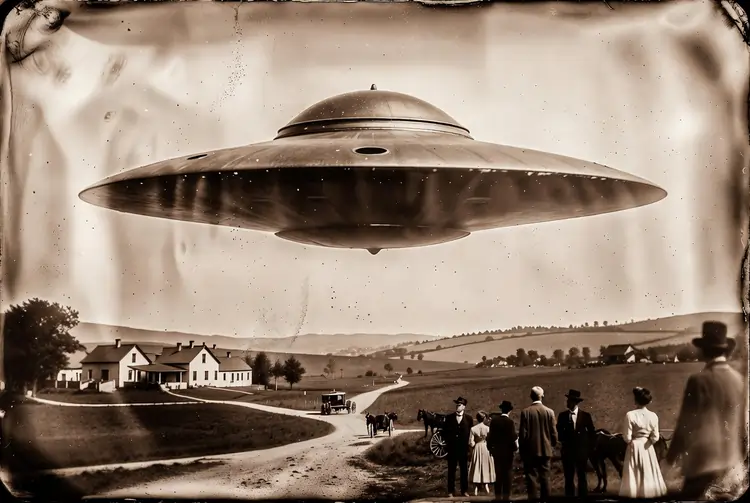
It began in the darkness of a July night. In the small village of Stirling, in the far south of the South Island, several residents swore they had seen lights moving through the air — lights that nothing, no carried lantern, no free balloon, seemed able to explain. The local newspaper, theClutha Free Pressof Balclutha, ran the story on 13 July 1909. New Zealand did not yet know it, but it had just opened one of the most mysterious aerial files in its history.
For over a month, what appeared to be "airships" of varying shapes and sizes crossed the country's skies. Witness reports flooded in from every corner of the land. In the areas where sightings were most frequent, residents gathered in the streets at nightfall, watching for what they had begun to call the"phantom ship."
"If it appears again within range, some of the beach boys are going to try to prick the bubble with a bullet."
— George Smith, quoted in the Clutha Leader, 27 July 1909Kelso, the epicentre of a national shockwave
It was around the township of Kelso, in Otago, that the sightings took on their most striking dimension. On 23 July 1909, at midday, schoolchildren and their teacher observed in broad daylight a craft they described as shaped like a boat, with what appeared to be the figure of a man seated inside. The machine came from the direction of the Blue Mountains, circled high above the school, and disappeared the way it had come.
The following day, a dozen tradesmen working six miles away trained their telescopes and field glasses on the object. From two miles' distance they made out a clear cigar shape, a carriage suspended beneath, and what looked like a propeller. Six child witnesses independently produced sketches of the craft — drawings the newspaper reproduced on 31 July. One boy noted that he had watched the propeller reverse before the vessel turned sharply. None of the children had ever drawn an aircraft before, and none knew what a dirigible was.
"The thing came up the harbour, apparently only twenty or thirty yards above the water, with extraordinary rapidity, and then rose suddenly, swung to the left, and disappeared over the hills in the direction of Anderson's Bay."
— Witness testimony collected at Otago Harbour
A methodical phenomenon: south to north
What strikes any retrospective observer is the geographical coherence of the reports. The first sightings occurred in the extreme south of the South Island — a region shaped by the gold rush years of earlier decades — before moving steadily northward. By August, accounts were arriving from Dunedin, Timaru, Geraldine, and Temuka. In September, it was from Gore that hundreds of people reported a dark cigar-shaped object over the Tapanui Hills between 4:30 and 6 p.m. on the 1st and 2nd.
When the wave subsided in New Zealand, similar sightings began to be reported from eastern Australia. The theory of a lone back-country inventor testing his machine in the wilderness collapsed entirely: no tinkerer could fly his contraption across the Tasman Sea.
First testimonies at Stirling — reported by theClutha Free Pressof Balclutha.
Daytime sightings at Kelso: schoolchildren, tradesmen, families. Six independent sketches produced by children.
Otago Daily Timesreports a very low-altitude appearance over Otago Harbour.
The phenomenon moves north: Nelson, Dargaville. Crowds gather in the streets every night.
Final peak of mass sightings at Gore — hundreds of simultaneous witnesses — before the phenomenon shifts toward Australia.
Unimpeachable witnesses, insufficient explanations
Among the witnesses were a locomotive engineer, dredge workers, Dunedin tradespeople, and a Presbyterian minister with his wife and children. The latter observed the object through "coloured glasses" and telescopes: a cigar-shaped silhouette, moving in complete silence. At night, the craft sometimes projected a light powerful enough to illuminate the slopes of surrounding hills.
At the time, no dirigible airship was operating over New Zealand. Count von Zeppelin's airships had been making their first flights in Europe since 1900, but their range was wholly incompatible with a transit to the southern hemisphere. The Wright Brothers had completed their first flight only in 1903, and their fragile machines were incapable of sustained night flight over any distance.
Sceptical newspapers offered their own solutions. Black swans misidentified in the dark, paper fire balloons with candles, the planet Mars, shooting stars. A farmer in the Black Hills found two petrol cans on a remote hilltop unreachable by any motor vehicle — and it was suggested an airship must have landed there to refuel. In the Otama district, another farmer discovered several screw wrenches lying in a field, and supposed an airborne crew had made repairs on the spot.
"It has come at last. We have been expecting the dread news for weeks…"
— Thames Star, mocking the collective hysteria after the Nelson sightingsA mystery history has never resolved
The memory of these events faded quickly — until researchers rediscovered, decades later, bundles of yellowing newspapers preserved at the National Library of New Zealand. ThePaperspastproject, which digitises the country's press heritage, has since made dozens of original witness accounts accessible to historians and researchers alike.
What endures is a question that neither the rationalism of 1909 nor our own has managed to close: what did those hundreds of witnesses actually see — ordinary men and women, scattered across two islands, with no connection between them — during those six weeks of the southern winter? A natural phenomenon collectively misread? A secret craft whose existence was never disclosed? Or something else entirely, for which the language of the time simply had no name?
The "phantom ship" of 1909 remains, to this day, without a definitive answer.
Gemini, CC0,

0 comments: