Stories of childhood reincarnation continue to fuel a field of research that is as discreet as it is unsettling. In Japan, Professor Ohkado Masayuki, a linguistics scholar, has gained recognition for his work documenting and analyzing cases in which children appear to recall memories from a previous life. Among the many cases he has studied, one investigated in depth beginning in 2015 remains particularly striking.
The story begins in the early 1990s with the death of a woman named Midori, a mother of three. Her passing in 1993 left behind a grieving family deeply attached to her memory. The following year, her daughter Atsuko married, moved away from the family home, and started her own family. In 1996, a baby girl was born: Tae.
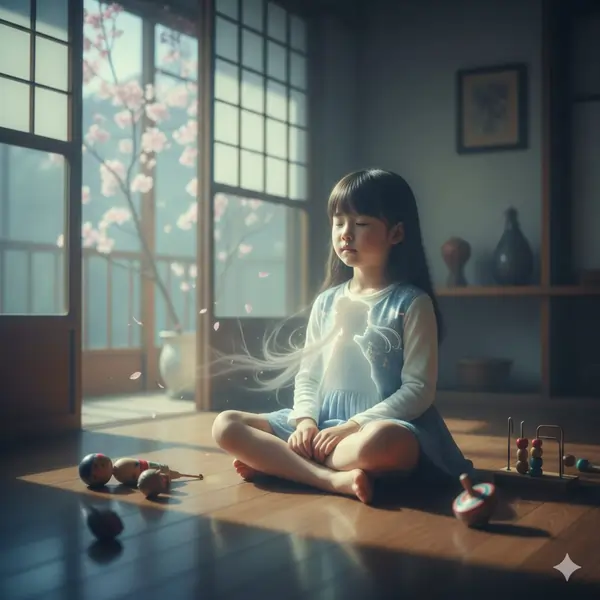
From an early age, Atsuko was troubled by a strange feeling. Something in her daughter’s behavior and expressions strongly reminded her of her own mother. It was a vague yet persistent impression that took an unexpected turn when Tae was only two years old. One day, Atsuko showed her daughter a photograph of Midori and said, “This is your grandmother.” The child’s response was immediate and unsettling: “Me.”
That moment marked the beginning of a series of disturbing events. The family, who practiced Zen, a spiritual tradition in which belief in reincarnation plays an important role, did not immediately dismiss the statement. Without dramatizing it, Atsuko nevertheless began to observe her daughter more closely.
A year later, when Tae was three, Atsuko went through a period of deep sadness connected to the memory of her deceased mother. One day, while the two were walking together, the little girl spontaneously said something that profoundly shook her mother: “I have to cheer her up.” For Atsuko, those simple words carried an intense emotional weight. She later explained that she felt, briefly but powerfully, as though Midori had somehow returned.
Intrigued by these accounts, Professor Masayuki conducted a series of in-depth interviews, incorporating this case into his broader research on spontaneous childhood narratives suggesting a previous existence. As with many similar cases studied around the world, these memories appeared to fade with time.
When Masayuki re-interviewed Tae several years later, in her late teens, the young woman retained no memory of Midori or of any statements related to a past life. The words spoken in early childhood had vanished, seemingly erased by time.
For the researcher, this later silence does not necessarily invalidate the experience. He points out that many such cases share a common feature: early memories—often vivid and emotionally charged—that gradually disappear as the child grows older and develops a distinct personal identity.
Caught between belief, psychology, and mystery, Tae’s story continues to raise fundamental questions about memory, consciousness, and the uncertain boundary between individual experience and the invisible legacy passed down through generations. A field of inquiry where, for now, certainty remains rare—and fascination enduring.
Gemini, CC0,